
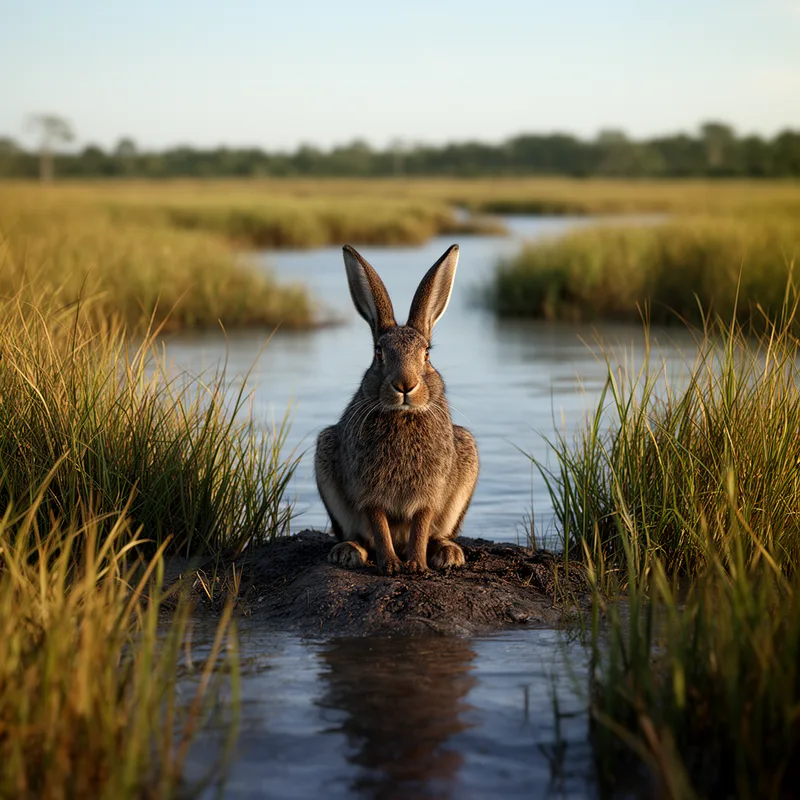
marsh hare
- noun
- /mɑrʃ hɛr/
- Specialized
- The marsh hare is rarely seen outside the wetlands of the southeastern United States.
Examples
-
Unlike the eastern cottontail, the marsh hare has longer legs suited for swampy terrain.
-
Biologists studied the diet of the marsh hare to understand its adaptation to brackish environments.
-
Look at that marsh hare!
-
The marsh hare is known for its long ears.
-
Biologists studied the diet of the marsh hare to understand its adaptation to brackish environments.
-
The marsh hare is rarely seen outside the wetlands of the southeastern United States.
-
Unlike the eastern cottontail, the marsh hare has longer legs suited for swampy terrain.
Synonyms

A small rabbit that lives in marshes along the southeastern United States coast
Surface Forms
Morphology
The meaning is directly derivable from combining 'marsh' (wetland) and 'hare' (a long-eared mammal): it straightforwardly denotes a hare that lives in marshes. This noun–noun compounding pattern is cross-linguistically common and follows normal English composition, so a B1 learner who knows both constituents will understand it.
Etymology
Marsh hare comes from a simple picture: a hare living in a marsh, a wet, grassy place near the coast. Because people saw this animal in swampy coastal areas, the name stayed and now refers to the rabbit that lives in those wet places.

