

man-of-war bird
- noun
- /ˈmæn əv wɔr bɜrd/
- US
- The man-of-war bird is known for its impressive wingspan and aerial agility.
Examples
-
Fishermen often spot the man-of-war bird flying high above tropical waters.
-
Have you ever seen a man-of-war bird in flight?
-
A man-of-war bird soared gracefully above the ocean, scanning for food.
-
The man-of-war bird soared gracefully above the ocean.
-
A man-of-war bird soared gracefully above the ocean, scanning for food.
-
Fishermen often spot the man-of-war bird flying high above tropical waters.
-
The man-of-war bird is known for its impressive wingspan and aerial agility.
Synonyms

 10
1.9
10
1.9

A bird that lives near the sea and often flies over water, like gulls or albatrosses
 1
7.8
1
7.8
Large tropical seabird with long wings and a forked tail that often steals food from other birds while flying
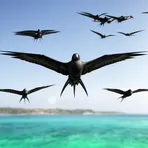
A group of large seabirds with long wings and a deeply forked tail

A group of large tropical sea birds with long wings, forked tails, and males' red throat pouches
Surface Forms
Morphology
man-of-war + bird
The overall meaning ('a large tropical seabird / frigatebird') cannot be predicted from the literal parts because 'man-of-war' is a non‑transparent compound (historically referring to a warship) and is not a common lexical item for B1 learners; combining it with 'bird' does not yield the specific notion of a frigatebird. This is essentially a species name/idiomatic compound whose referent and characteristics are not derivable from the constituent words, so learners who only know the parts would likely be unable to infer the MWE's meaning.
Etymology
The noun man-of-war bird comes from sailors. One popular story says they called it a man-of-war — the old word for a 'warship' — because the bird flies fast, follows ships and sometimes steals food from other birds, so the name stuck for this large seabird.