
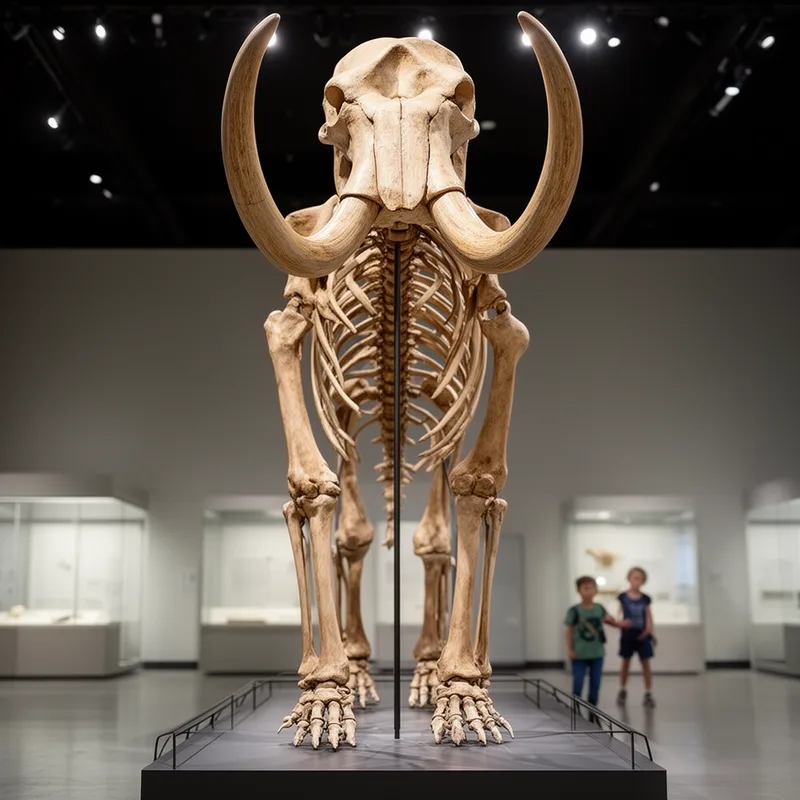
mammoth skeleton
- noun
- /ˈmæməθ ˈskɛlɪtən/
 :
esqueleto de mamut
:
esqueleto de mamut
- The archaeologists carefully excavated the mammoth skeleton to preserve it for future study.
Examples
-
He also lost all his "anatomical instruments," his "mineralogical apparatus," and even 130 copper plates for engravings, including the large plate of the mammoth skeleton.
Academic text (1993) -
The museum displayed a complete mammoth skeleton that drew thousands of visitors each year.
-
Researchers studied the mammoth skeleton to learn more about the species' behavior and environment.
Synonyms
 316
3.6
316
3.6

The preserved remains of a very old plant or animal in rock
 114
2.3
114
2.3
A frame of bones and cartilage that supports a body
 3
4.6
3
4.6
A set of bones that supports and gives shape to a person or animal
How Complete

Surface Forms
Morphology
The compound is directly compositional: a B1 learner who knows 'mammoth' (the animal) and 'skeleton' (the bones of an animal) will naturally infer it means the bones/remains of a mammoth. This is a transparent noun–noun combination with no idiomatic or metaphorical shift and is cross-linguistically straightforward.
Etymology
Mammoth skeleton refers to the large, old 'bones' of a giant mammoth and to the skeleton made when those bones are put together so the animal looks as it did in life. People see these displays in museums or after the bones are dug from frozen ground, so the phrase means the preserved bones shown as the animal once stood.