
magnetoresistance


 1
8.2
- noun
- /ˌmæɡnɪtəʊrɪˈzɪstəns/
- Specialized
- Farther down the road, graphene nanoribbon edge states open the possibility of devices with tunable giant magnetoresistance and other magnetic and optical effects.
- colossal magnetoresistance
- giant magnetoresistance
- magnetoresistance exhibits
Examples
-
Over the past decade, manufacturers have exploited the phenomenon of giant magnetoresistance (GMR) to build sensors for reading data bits coded as tiny magnetized regions on disk drives.
Academic text (2004) -
In today's GMR devices, the magnetoresistance, defined as the percentage difference in resistance between the parallel and antiparallel configurations, is around 10-15%.
Academic text (2004) -
Tunneling magnetoresistance as a function of magnetic field.
Academic text (2004) -
They are exploring probe tips for two modes of reading: one based on magnetic force and the other on magnetoresistance.
Academic text (2002) -
Early attempts to produce high tunneling magnetoresistance (TMR) were unsuccessful, however.
Academic text (2004) -
Scientists have already begun to develop new spin-based electronics, beginning with the discovery in 1988 of the giant magnetoresistance (GMR) effect.
Blog text (1) -
Antidot arrays also exhibit intriguing magnetoresistance properties that have been successfully explained by classical ballistic trajectory models.
Academic text (1994) -
Replacing an amorphous insulating barrier with a crystalline barrier has produced a threefold increase in the room-temperature magnetoresistance.
Academic text (2004) -
Both experiments were motivated by theoretical papers predicting magnetoresistance values of 1,000% or more for tunnel junctions made with crystalline insulating layers.
Academic text (2004) -
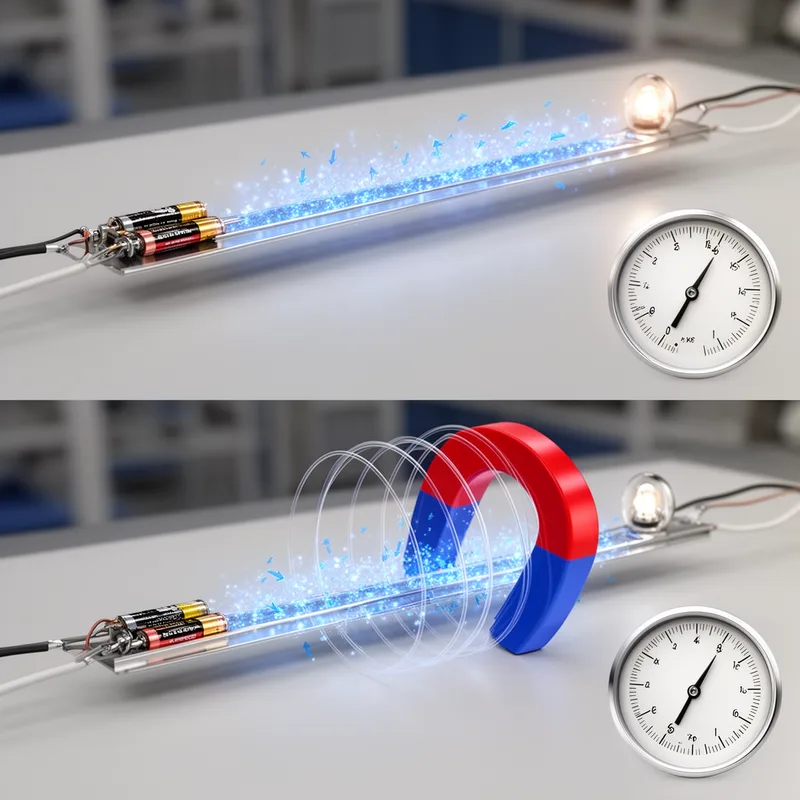
The change in resistance due to a magnetic field is known as magnetoresistance.
Surface Forms
Morphology
magnetoresistance = magneto + resistance (semi-transparent) = magneto + resistance
The components 'magneto' and 'resistance' are clear, but the specific scientific phenomenon is specialized.
Etymology
The word magnetoresistance combines magneto- (from magnet, 'an object that pulls metal') and resistance (from resist, 'to push back'). So, magnetoresistance means the change in a material's electrical resistance when a magnet or magnetic field is near.