

magnetic compass


 1
3.1
1
3.1
- noun
- /mæɡˈnɛtɪk ˈkʌmpəs/
- This is why, since we operate for years of consecutive tours in "third or fourth world nations," we train to survive with minimal or no high-tech resources or electricity, especially in the lost art of paper maps and magnetic compass land navigation.
Examples
-
This is because the Earth itself acts like a big magnet and throws the reading of a magnetic compass off a little bit.
Academic text (2012) -
And my friends, a built-in, genuine magnetic compass, there you are.
-
I was thinking about replace Him with one of those magnetic compasses, you know, but I usually end up going the wrong direction anyway.
-
In the Middle Ages, we see things like the crossbow, the sea rudder, and the magnetic compass.
Academic text (1995) -
Magnetic compass, on.
-
Navigation is accomplished using a gyro-stabilized, solid-state magnetic compass unit and an electronic depth sensor.
Academic text (2008) -
Installation Site Magnetic Compass Reading Installation Site Declination Installation Site Degrees + or - True South Adjusted for Declination
Academic text (2012) -
A GPS receiver is, in many ways, a highly technologically advanced version of the magnetic compass, but with capabilities that far surpass traditional orienteering.
Academic text (2003) -
Many of the Chinese advances from the Tang dynasty in science and engineering beyond gunpowder, paper, the magnetic compass, etc. didn't show up in the British patent office until the 19th century.
Blog text (18) -
Sailors rely on a magnetic compass to navigate when electronic devices fail.
Synonyms
 62
1.6
62
1.6
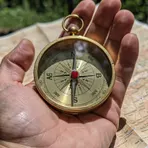
A tool that shows direction with a needle pointing north
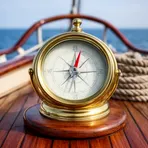
A tool on a ship that shows direction by a needle pointing north
How Accurate

Surface Forms
Morphology
The meaning is directly and predictably derived from combining 'magnetic' (relating to Earth's magnetic field) with 'compass' (a device indicating direction); a learner who knows both words will readily infer it is a compass that uses magnetism. This adjective+noun composition is a regular, cross-linguistically common pattern, so the phrase is immediately comprehensible to B1 learners.
Etymology
Magnetic compass comes from a simple tool sailors used long ago: a small magnetic needle inside a box that always turned to point toward the Earth's 'north', so people used it as a compass to find 'direction'. That's why a magnetic compass today means a device that shows direction using a magnet.