

maglev
 3
7.3
3
7.3

- noun
- /ˈmæɡˌlɛv/
- Specialized
- Both the Baltimore-Washington and Pittsburgh maglev semi-finalists have selected Transrapid systems in their proposals.
- maglev train
- maglev vehicle
- maglev routes
Loading YouTube…
Watch on YouTubeThese trains are also known as maglev, short for magnetic levitation.
- These trains are also known as maglev, short for magnetic levitation.
- Maintenance, nightmare maglev, Nothing is contacting.
Examples
-
Final preparations wind down as a Shanghai maglev train awaits its journey from the factory in Kassel, Germany, to China.
Academic text (2002) -
The Japanese maglev train traveled at incredible speeds, soaring above the tracks without touching them.
-
However, the Japanese maglev train, called LO, will be the first of its kind.
-
But first, the team here said they'd let me stand by the track as the maglev goes past at speed.
-
These trains are also known as maglev, short for magnetic levitation.
-
High-speed maglev trains hover within reach of the United States as China puts one on the ground.
Academic text (2002) -
However, the new Maglev trains in Japan, for instance, have to be going 170 kilometers per hour to levitate.
-
At Virginia's Old Dominion University, a crane lowers a maglev vehicle toward the guideway.
Academic text (2002) -
Preproduction maglev trains travel at 270 mph, and some prototypes are expected to exceed 300 mph.
Academic text (1994) -
For intracity transit, maglev's quiet operation at speeds below 125 mph suggests a major economic advantage over traditional subways.
Academic text (2002)
Synonyms
 17
3.7
17
3.7
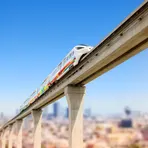
A train that runs on a single rail above the ground
 5
2.8
5
2.8
A very fast passenger train that runs on special tracks like those in Japan
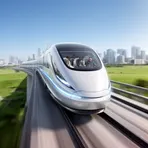
A very fast passenger train with modern technology
How Fast

Surface Forms
Morphology
maglev = magnetic + levitation (semi-transparent) = mag + lev
Formed by blending 'magnetic' and 'levitation'; 'mag' is obvious but 'lev' is not a standalone English morpheme and the compound is technical, so full meaning may not be predictable to average learners.
Etymology
Maglev comes from magnetic and levitation, where 'magnetic' is about magnets and 'levitation' means 'to lift' or 'float'. So a maglev train literally floats above the track using magnets, which keeps it from touching the rails and lets it go very fast.