
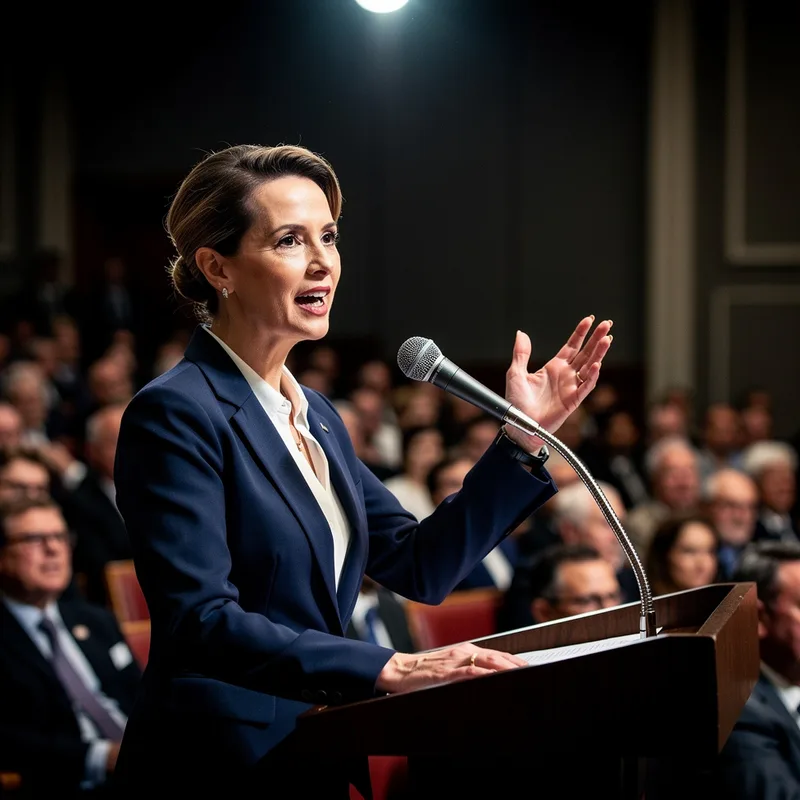
to make a speech
 35
2.8
35
2.8

- phrasal verb
- /meɪk ə spiːtʃ/
- Formal
- Come on, you gotta get to Manhattan and make a speech.
- go make a speech
- the president made a speech
- stand up to make a speech
Loading YouTube…
Watch on YouTubeBy the time I make a speech, I am very convinced of my case.
- By the time I make a speech, I am very convinced of my case.
- When she sings the songs, I look at her, wow, that's the way that you make a speech because I never know how to make speech because I'm not an actor.
Examples
-
The mayor will make a speech at the community event to discuss future plans for the city.
-
The Prime Minister will now make a speech from the Cabinet War Rooms in Downing Street.
-
And develop your own vision and then make a speech about what you stand for and then develop the different programs around that.
-
It's not like I have to make a speech now.
-
You know, it's really not required for you to make a speech.
-
On my birthday last year someone made a speech in my honor.
-
You know when I come here most is when I have to make a speech, and I get nervous.
-
I was not keen to make a speech in front of an audience.
Fiction book (1993) -
He got up and made a speech at a Friedman's political meeting.
-
A short time later, the president made a speech that was thought to indicate a retreat from Clinton globalism.
Academic text (1996)
Synonyms
 ∞
3.2
∞
3.2
To give a formal talk to a group of people
 8
3.3
8
3.3
To give a formal talk to an audience
 5
3.9
5
3.9
To talk in front of a group of people
 5
7.4
5
7.4
Talk for a long time about a subject, like giving a lecture
 2
4.2
2
4.2
Stand up and begin speaking in a meeting or debate
 1
9.4
1
9.4
To give a long formal speech that sounds boring and self-important

To end a formal speech with a long, strong summary
Antonyms

How Formal

Surface Forms
Morphology
The meaning is directly derivable from combining 'make' (to produce/perform) with 'speech' (a planned oral address); the article 'a' does not affect meaning. Although 'give a speech' is a more frequent collocation, a B1 learner who knows the constituents can readily infer 'make a speech' means to deliver a formal talk, and this compositional pattern is cross-linguistically common.
Etymology
The phrase make a speech comes from the simple idea in its parts, make meaning 'to prepare' and speech meaning 'a set of words', so someone prepares words and then says them out loud to a group. That's why it means 'to deliver a formal talk' to an audience.