
lysosomal
 2
8.1

- adjective
- /ˌlaɪsəˈsoʊməl/
- Specialized
- Research has shown that many lysosomal diseases can lead to the accumulation of toxic substances in the body.
- lysosomal storage
- lysosomal enzymes
- lysosomal disorder
Examples
-
It is still worth keeping an eye on this research as we know that the decline in lysosomal function (and thus of cellular housekeeping) is important in animal aging.
Blog text (17) -
Some, however, were characterized by the presence of many lysosomal granules in the cytoplasm.
Academic text (2001) -
Gaucher's disease is the most common lysosomal storage disorder.
Academic text (1996) -
The lysosomal system can be manipulated by drugs and has already been identified as a therapeutic target in both Alzheimer's disease and the prion encephalopathies.
Academic text (1992) -
My theory works for Pompe, and eventually it'll work for enzyme replacement therapies for other lysosomal storage disorders.
-
However, in children, CTS is usually secondary to an underlying pathology, such as lysosomal storage diseases, particularly mucopolysaccharidosis and mucolipidosis.
Academic text (2015) -
If the ingested bacteria have no intracellular survival mechanisms, the bacteria-containing phagosomes fuse with the lysosomal compartment, and bacteria are digested within 15-30 minutes.
Academic text (2017) -
In addition, staining with Lysotracker Red DND-99 allows for visualizing lysosomal structures. It is critical that the Lysotracker Red dye is present during the imaging process, as washing steps reduce the signal to a level that becomes too low for visualization.
Blog text (4) -
Gaucher's disease is the most common lysosomal storage disorder.
-
Understanding lysosomal function is crucial for developing treatments for certain metabolic disorders.
Surface Forms
Morphology
lysosomal = lysosome (transparent) = lyso + som + al
The adjective meaning is directly derived from the noun 'lysosome' by adding the regular relational suffix '-al'.
Etymology
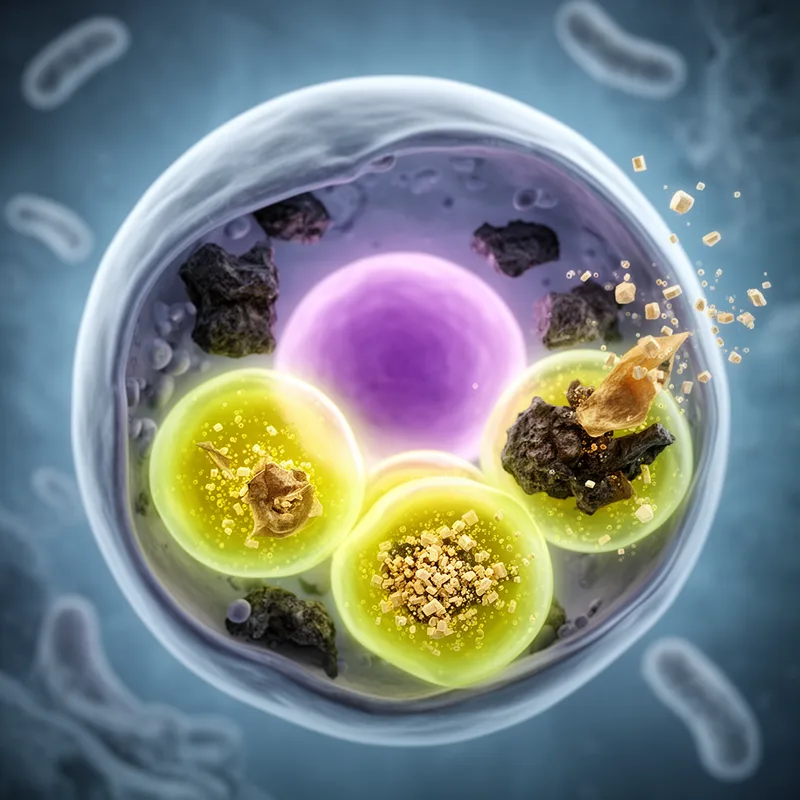
Lysosomal comes from the cell part lysosome, whose name comes from Greek lyso- 'to break down' and -soma 'body'. So lysosomal describes things related to lysosomes, the cell 'bodies' that 'break down' waste inside cells.