
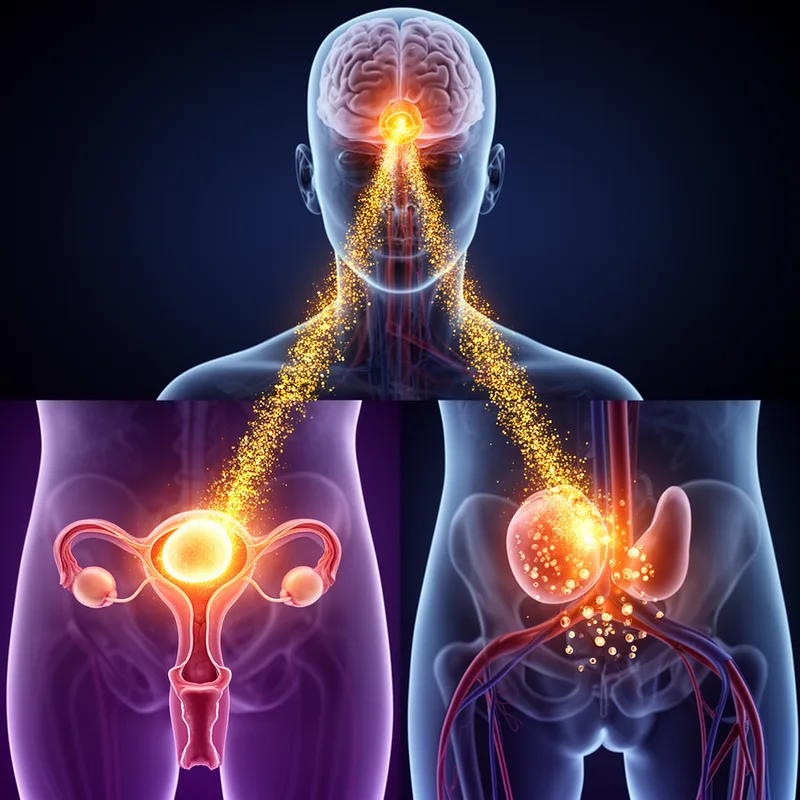
luteinizing hormone
- noun
- /ˈluːtəˌnaɪzɪŋ ˈhɔːrmoʊn/
- Specialized
- Doctors often measure luteinizing hormone levels to assess reproductive health in both men and women.
- luteinizing hormone (LH)
- luteinizing hormone and follicle
Examples
-
A fertility monitor captured data on peak luteinizing hormone concentrations indicative of ovulation.
Academic text (2015) -
The pituitary gland produces and stores luteinizing hormone (LH) and follicle-stimulating hormone (FSH).
Academic text (2012) -
The fertility monitor detected a surge in luteinizing hormone, indicating that ovulation was about to occur.
-
A high level of luteinizing hormone in the blood can signal a problem with the pituitary gland.
Synonyms
 2
8.5
2
8.5

A hormone that causes an egg to leave the ovary and helps men make testosterone


 1
9.8
1
9.8
A hormone that causes women to release an egg and makes men's sex glands produce testosterone

A hormone from a small gland in the brain that makes females release eggs and males produce male hormones
Surface Forms
Morphology
The phrase is compositionally transparent: 'luteinizing' means causing luteinization (inducing formation of the corpus luteum) and 'hormone' is a chemical messenger, so together they denote a hormone that causes luteinization. Although technical/medical, the adjectival modifier + noun pattern is regular and cross-linguistically common, so a learner who knows both constituents can infer the meaning.
Etymology
The term luteinizing hormone comes from lutein, a word meaning 'yellow', because the hormone causes a small part of the ovary to turn yellow after it releases an egg. So, the name links to its job: it triggers 'ovulation' in women and helps make male hormones in men.