
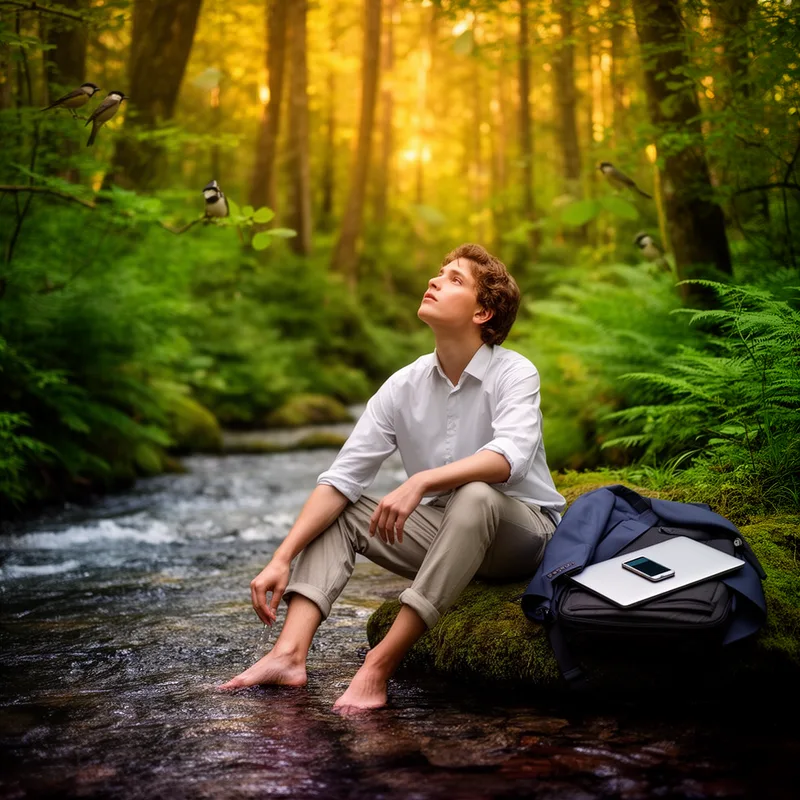
to lose oneself in nature
- phrasal verb
- During his vacation, he lost himself in nature while exploring the national park.
Examples
-
Many people lose themselves in nature as a way to escape the stresses of urban life.
-
And one of the most reliable ways I've found to lose myself is being in nature.
-
She can lose herself in nature for hours, listening to the birds and watching the trees sway.
Synonyms

 59
4.8
59
4.8

Make someone fully involved in an activity or interest
 28
4.2
28
4.2
To become fully involved in an activity or subject
How Immersed
 379
1.3
379
1.3
Surface Forms
Morphology
The phrase combines literal constituents whose meanings point toward the idiomatic sense: 'lose' + 'oneself' suggests losing awareness of oneself and 'in nature' specifies the setting, so a learner who knows the figurative sense of 'lose oneself' can infer the MWE. However, the reflexive construction and the metaphorical sense of 'losing oneself' (becoming absorbed) are not wholly literal and may require prior exposure for some B1 learners, so it is only partly transparent. Cross-linguistically similar expressions (e.g., Spanish 'perderse en la naturaleza') increase its accessibility but do not make it fully compositional.
Etymology
Lose oneself in nature paints a simple picture: a person walks into the woods and so completely lose oneself among the trees and birds that city worries fade away in the nature around them. That's why it now means 'to become deeply absorbed' and forget daily concerns.