
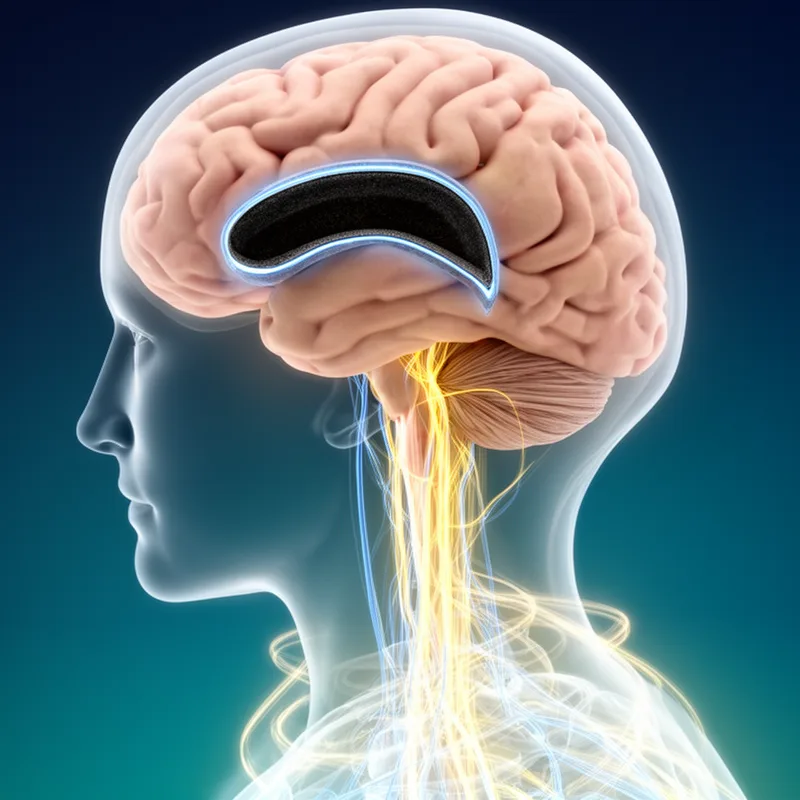
locus niger
- noun
- /ˈloʊkəs ˈnaɪɡər/
- Specialized
- Researchers studied the locus niger to better understand the effects of dopamine loss in the brain.
Examples
-
Damage to the locus niger can result in movement disorders such as Parkinson's disease.
-
In Huntington's disease, the locus niger may show metabolic abnormalities similar to those seen in Parkinson's.
-
The locus niger plays a crucial role in motor control.
-
Researchers are studying the locus niger to understand Parkinson's disease.
-
Damage to the locus niger can result in movement disorders such as Parkinson's disease.
-
In Huntington's disease, the locus niger may show metabolic abnormalities similar to those seen in Parkinson's.
-
Researchers studied the locus niger to better understand the effects of dopamine loss in the brain.
Synonyms



 1
8.1
1
8.1
A dark middle part of the brain that helps control movement and is affected in Parkinson's disease

A dark part in the middle of the brain that helps control movement
Surface Forms
Morphology
locus + niger
The phrase is a Latin technical compound: 'locus' = place/location and (if known) 'niger' = black, so a learner who knows the constituents could infer a literal meaning like 'black place'. However, the specific anatomical referent and its functional details (a pigmented midbrain layer involved in motor control) are specialised and not predictable from the literal parts alone, and 'niger' is not a common English lexical item, so understanding would be only partial.
Etymology
Locus niger comes from Latin and literally means 'black place'; locus is 'place' and niger is 'black', because this brain area looks dark from many dark cells. That's why the name helps you remember it is the dark spot that helps control movement and is affected in conditions like Parkinson's disease.