
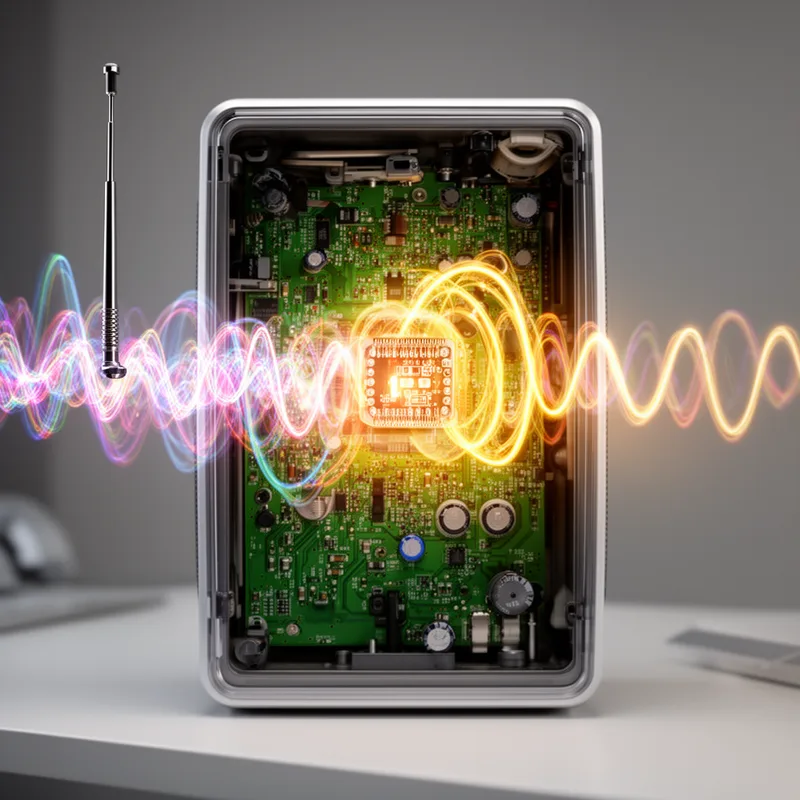
local oscillator
- noun
- /ˈloʊkəl ˈɒsɪleɪtər/
- Specialized
- In a radio receiver, the local oscillator generates a signal that is combined with incoming frequencies for better processing.
Examples
-
To decode this signal, a receiver's local oscillator must lock onto both the frequency and the phase of the pilot carrier so that it can demodulate the RF and recover the sequence of symbols.
Academic text (1999) -
Once the local oscillator is locked, the receiver begins searching the demodulated signal for segment sync symbols.
Academic text (1999) -
The local oscillator tuned to the correct frequency allowed the radio to pick up clearer signals from distant stations.
-
As part of its operation, the local oscillator creates new frequencies that help in demodulating the received radio signal.
Synonyms

A circuit that makes a radio signal to combine with incoming signals to make new frequencies in radios
How Stable


Surface Forms
Morphology
The phrase is compositionally built from 'local' + 'oscillator', so a learner can infer it denotes an oscillator that is internal or situated 'locally' in a device. However, the crucial technical function (that it mixes with an incoming signal to produce intermediate frequencies) is specialized and not derivable from the common meanings of the constituents, making the overall sense only partially predictable.
Etymology
Local oscillator comes from radio work: local means 'nearby' and oscillator is a device that makes a repeating wave. The image is a small wave-maker put near a radio to 'mix' with an incoming 'signal' and make new 'frequencies', so the term now means a nearby device used to tune and process radio signals.