
lignin
 2
9.6
2
9.6

- noun
- /ˈlɪɡnɪn/
- Specialized
 :
lignina
:
lignina
- Pretreatment frees the cellulose from hemicellulose, starch, and lignin components.
- cellulose and lignin
- hemicellulose and lignin
- lignin in the wood
Plus, the structure is strong even without lignin.
- Plus, the structure is strong even without lignin.
Examples
-
Special enzymes are used to separate the lignin from the cellulose, which yields sugars that can be refined into ethanol.
Academic text (2007) -
Some materials, like softwood, have enough all-natural lignins in them that work as a binder.
Blog text (17) -
Different proportions of lignin in the two raw materials.
Blog text (29) -
The Genencor material has worked extremely well in speeding up the process, but lignin takes so long to break down.
Academic text (1999) -
The lignin component is not fermented but can be burned to produce energy.
Academic text (2002) -
Woody tissues in trees consist primarily of cellulose and lignin.
Academic text (2004) -
For example, laccase genes are thought to play an important role in the decomposition of high-lignin plant material.
Academic text (2008) -
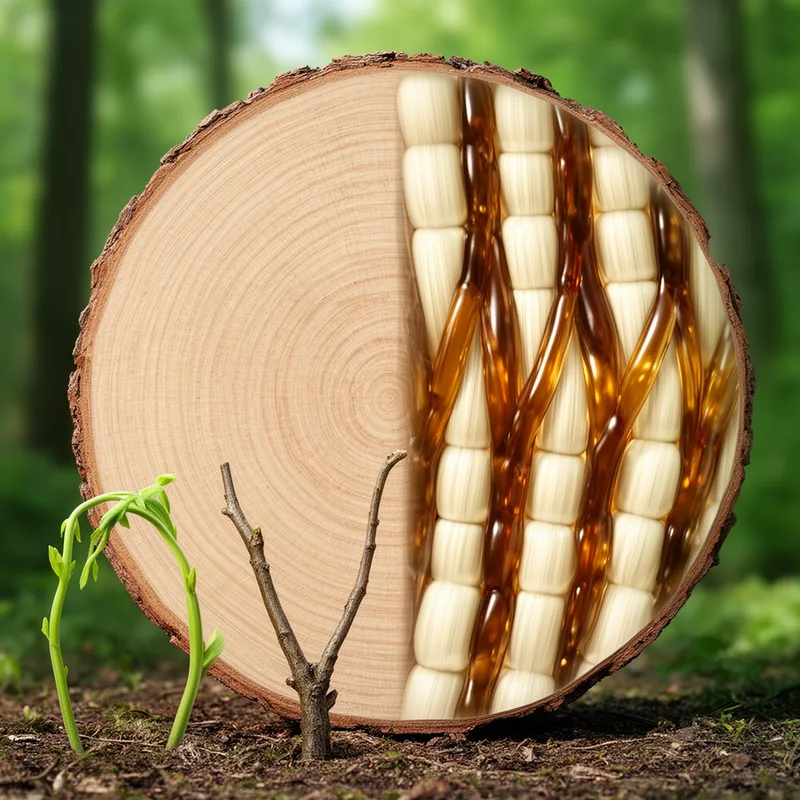
And the cell wall itself is made-up of cellulose fibrils in a matrix of lignin and something called hemicellulose.
-
The greatest differences in cellulose decay rates were between maple (high) and oak (low), whereas the greatest differences in lignin decay were between beech (high) and oak (low).
Academic text (2008) -
Lignin is an important component of wood, providing plants with structural support and rigidity.
Surface Forms
Morphology
lignin = lign + in
The root 'lign' is not a standalone English word familiar to learners and the chemical suffix '-in' does not make the meaning 'wood-related polymer' predictable for an average B1 learner.
Etymology
Lignin comes from the Latin word lignum, meaning 'wood'. Think of lignin as the plant's natural 'glue' that binds the fibers and makes stems and trees hard and woody, so the origin explains why the word names the material that gives wood its strength.