

leaf beetle
- noun
- /liːf ˈbiːtəl/
- It is quite DED-resistant, but like Homestead, has some susceptibility to the elm leaf beetle.
- elm leaf beetle
Examples
-
It has a V-shaped crown like the American elm, but is shorter and resistant to Dutch elm disease and the elm leaf beetle.
Academic text (1996) -
Recent analysis by Karlen and his associates pinpointed the soybean leaf beetle as the culprit.
Academic text (2002) -
The leaf beetle Diorhabda elongata is the first approved biological control agent for saltcedar in the United States.
Academic text (2000) -
Townsend has also worked cooperatively with Richard Hall of Ohio State University, screening elms for elm leaf beetle tolerance.
Academic text (1996) -
Swamp milkweed leaf beetle (Labidomera clivicollis) larvae of various stages feed together.
Academic text (2002) -
Ohio is a lacebark elm selection that is moderately V-shaped, with excellent resistance to the elm leaf beetle and Dutch elm disease.
Academic text (1996) -
But in recent years, the bean pod mottle virus has emerged as a new pathogen of soybeans in Ohio, along with increased populations of its carrier, the bean leaf beetle.
Academic text (2005) -
The leaf beetle is known for its bright colors and leaf-eating habits on agricultural crops.
-
Farmers often struggle with infestations from the leaf beetle, which can cause significant damage to their plants.
-
The larvae of the leaf beetle typically feed on the roots, making them a concern for gardeners.
Synonyms

 95
1.0
95
1.0

A small insect with hard front wings that cover its back and a mouth for chewing
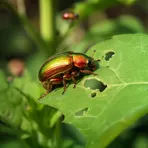
A small brightly colored beetle that eats plant leaves
Surface Forms
Morphology
The meaning 'a beetle that feeds on plant leaves' is directly and compositionally derived from 'leaf' (plant organ) + 'beetle' (insect); the compound simply names a beetle associated with leaves. This noun–noun formation is a common, literal naming pattern cross-linguistically, so a B1 learner who knows both constituents would readily infer the meaning.
Etymology
The compound leaf beetle was named for a clear picture: the beetle sits on and eats the plant leaf. So the name means 'a beetle that eats leaves', and its young can also harm roots and stems.