
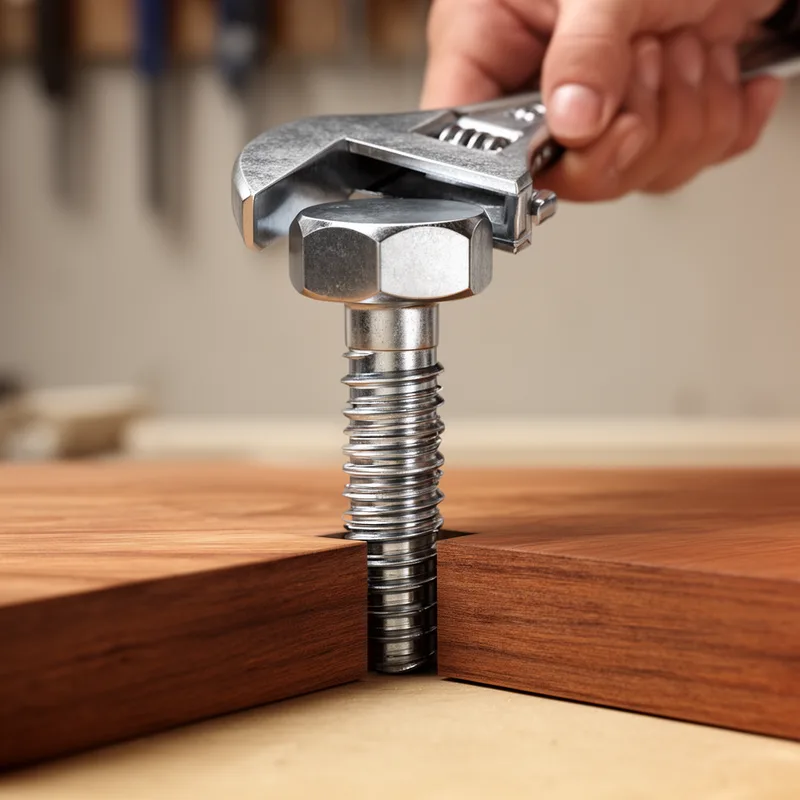
lag bolt


 1
6.7
1
6.7
- noun
- /læɡ boʊlt/
- US
- inch lag bolt
- 1/2-inch lag bolt
- 4-inch lag bolt
Examples
-
-Herb, I told you to use a lag bolt!
-
I need lag bolts, especially one-inch standard.
Fiction book (2002) -
The wall is fixed on four points with lag bolts 60 x 8mm (you can see them in the pictures in rows 5 and 13 from below) to short joists with a profile of about 100 x 50 mm.
Blog text (18) -
They now slanted down toward the beech that had lost its canopy, and the strain caused by the change had splintered the beams where they were attached by lag bolts to that tree, making the tree house too hazardous to enter.
Academic text (2001) -
To secure the wooden beams together, use lag bolts for a strong hold.
-
When constructing the deck, make sure to fasten the planks with lag bolts for added stability.
-
The carpenter selected long lag bolts to attach the heavy timbers firmly to the frame.
Synonyms

A large strong screw with a square or six-sided head driven with a wrench into wood to hold heavy things
How Heavy

Surface Forms
Morphology
lag + bolt
Although 'bolt' clearly signals a headed rod or screw, the modifier 'lag' is not used by learners with its technical sense here (and the provided dictionary entry is missing), so a B1 learner who knows the common meaning of 'lag' ('to fall behind') would not infer 'heavy screw used in timber work'. This is a specialised, term-like compound whose meaning is domain-specific rather than compositionally predictable, so it will be opaque without prior exposure.
Etymology
Lag bolt may come from old building work where strips of wood called 'lag' or 'lagging' were used and a strong metal bolt was driven in to hold them. That's why today lag bolt means 'a heavy screw for fastening big pieces of wood'.