

knapweed


 1
9.9
1
9.9
- noun
- /ˈnæpˌwiːd/
- Abandoned farms provide habitat for Gunnison prairie dogs and allow the spread of pernicious weeds such as Russian knapweed and camelthorn.
- Russian knapweed
Examples
-
Weeds, such as leafy spurge and spotted knapweed.
Academic text (2003) -
Right away, she started to kick, and the cowboy jumped back and knocked us both down in the knapweed and thistles.
Fiction book (1994) -
Then there's knapweed reportedly brought to this country by someone who loved it in their native land and wanted to bring it with them.
Blog text (1) -
Through this network, the Frederick lab recently acquired four good candidate pathogens: two on Russian thistle, one on Russian knapweed, and another on common groundsel.
Academic text (2000) -
Like I've actually planted leafy spurge and knapweed into experimental plots.
-
Research by Walker and others has shown that sheep can be used to manage noxious weeds, such as leafy spurge, spotted knapweed, and tall larkspur.
Academic text (1995) -
Led by Douglas G. Luster, the Frederick lab is the first stop in a national campaign to reunite exotic weeds like yellow starthistle and Russian knapweed with their homeland's natural enemies.
Academic text (2000) -
Major weed targets now include leafy spurge, saltcedar, Russian and yellow starthistle, Russian knapweed, and perennial mustards such as hoary cress.
Academic text (2000) -
The colorful knapweed blooms attract various pollinators during the summer months.
-
Many farmers struggle to control the spread of knapweed in their fields due to its aggressive growth.
Synonyms
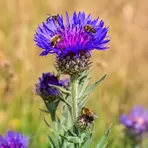
A flowering plant like knapweed or star thistle

A tall plant from Europe with purple flower heads that lives for several years
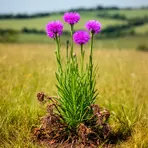
A tall European plant with purple flower heads that comes back each year
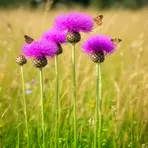
A tall plant with purple, thistle-like flowers that grows in meadows
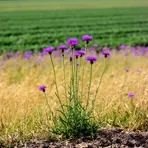
A wild plant with thin stiff stems and purple flower heads that grows in meadows and often spreads into fields
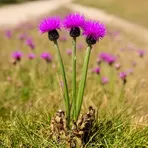
A plant that lives for many years with tough stems and bright purple flower heads

A wild plant common in meadows with strong stems and purple flowers that attract insects

A wildflower with thin stems and small purple flower heads

A plant from Jersey with bright purple flowers often grown in gardens
Compounds
A plant that lives for many years with tough stems and bright purple flower heads
- Specialized
A wild plant common in meadows with strong stems and purple flowers that attract insects
Surface Forms
Morphology
Etymology
Knapweed comes from an old English word cnæp meaning 'little knob' or 'head' and the word weed meaning 'plant'. The plant has round, button-like flower heads, so the name helps you remember it as a 'knob-like' or head-shaped wild plant.