
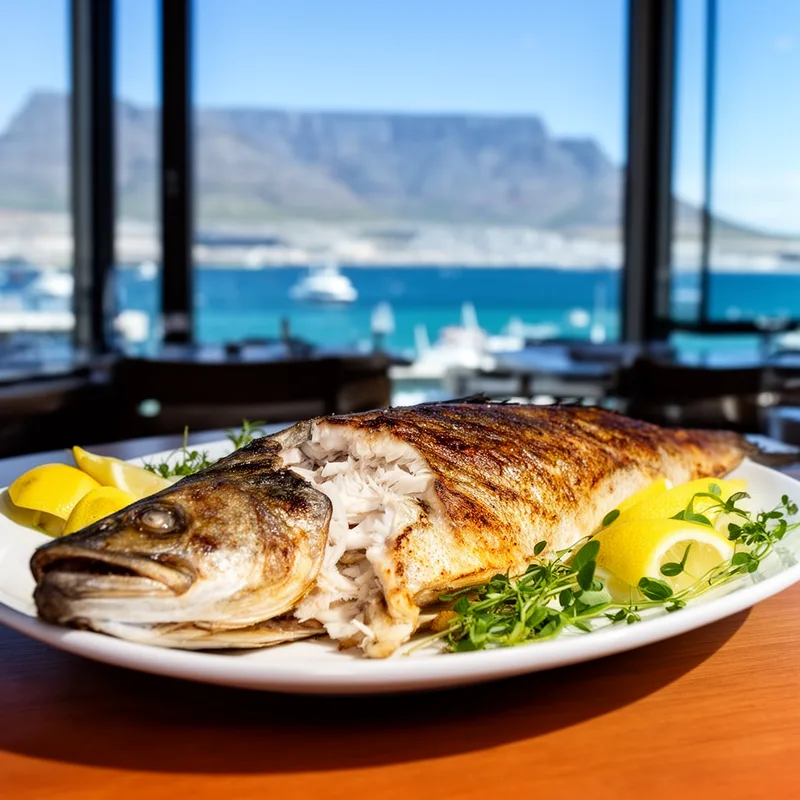
kingklip
- noun
- South African
- A popular dish in South Africa is grilled kingklip served with lemon and herbs.
- kingklip and sole
Examples
-
Kingklip is a by-catch, as in the offshore trawl fishery.
Academic text (1994) -
The mass of seal-damaged sole and seal-bitten kingklip was recorded from a total of 991 landings, during which time over 1,068 t of sole and over 133 t of kingklip were landed.
Academic text (1994) -
With kingklip, there is a loss of landed mass as a result of the trimming of fish to remove seal damage.
Academic text (1994) -
For kingklip, it is assumed that a third of the mass of each damaged fish is lost as a result of the seal bite and trimming.
Academic text (1994) -
Overall, the loss through seal depredation of sole and kingklip is calculated as R69,728 (US$18,827).
Academic text (1994) -
This is most likely to be at least partially attributable to the fact that sole can be pulled through the net easily and in this way can be removed whole (and therefore are not recorded in the catch), whereas seals can only bite those parts of kingklip that protrude through the net.
Academic text (1994) -
Although the 1992 landings were 200 t, the potential landing, if no seal damage had occurred, could have been 208.1 t, providing an estimate of damaged kingklip at 8.1 t.
Academic text (1994) -
Kingklip is marketed in various forms, so seal-damaged fish (Fig. 6b) is only regarded as a loss of mass, not a loss in the price per unit mass.
Academic text (1994) -
PHOTO (BLACK & WHITE): Figure 6. Seal-damaged sole (a) and kingklip (b) from the inshore demersal fishery. Photo a by P. Sims and Photo b by L. Taylor.
Academic text (1994) -
The mass of seal-damaged sole and seal-bitten kingklip was recorded from a total of 991 landings, during which time over 1,068 t of sole and over 133 t of kingklip were landed.
Academic text (1994)
Surface Forms
Etymology
Kingklip comes from Afrikaans words koning ('king') and klip ('rock'). Fishermen likely called this large, tasty fish the 'king of the rocks' because it lives near rocks in the sea and is popular to eat, which explains the name.

