
kinetochore


 1
9.9
- noun
- /ˈkɪnɪtəˌkɔr/
- Specialized
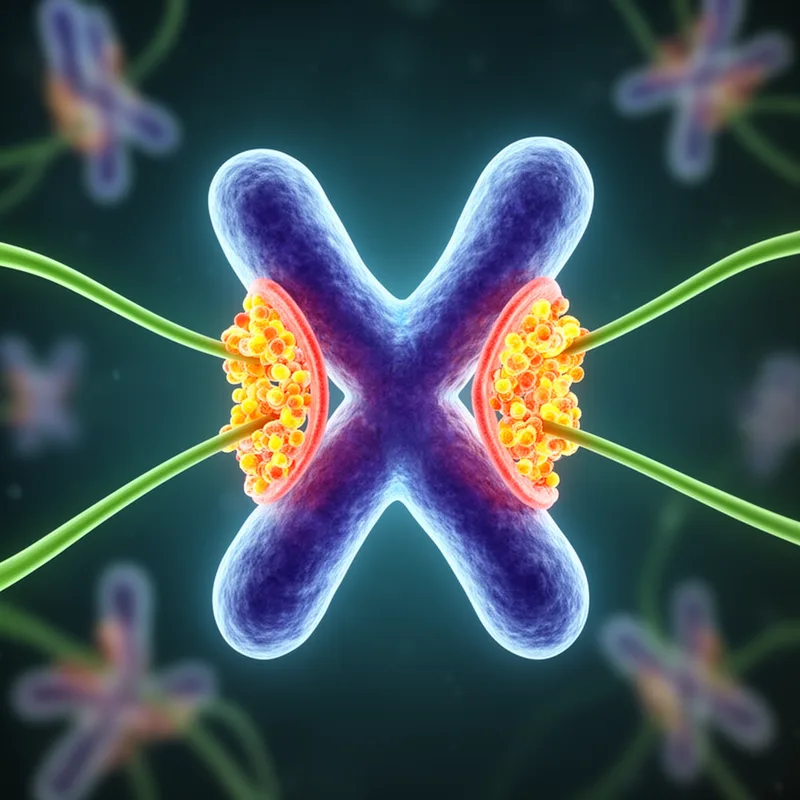
- During cell division, the kinetochore forms on the centromere of each chromosome, where it captures spindle fibers.
- kinetochore microtubules
- kinetochore assembly
- kinetochore proteins
Examples
-
In addition, the kinetochore plays a key role in the molecular checkpoints of cell-cycle progression.
Academic text (2009) -
In prophase, the kinetochore appears to be a ball inserted into a dense cup.
Academic text (2009) -
Here, we detail some of the results relevant to kinetochore structure and function.
Academic text (2009) -
Here we review recent progress in our understanding of a key player, the kinetochore, in these processes.
Academic text (2009) -
The latter does not directly involve the kinetochore and therefore will not be discussed here.
Academic text (2009) -
Figure 5. Activities of the kinetochore during the course of mitosis.
Academic text (2009) -
CREST staining showed for the first time that kinetochore proteins are present throughout the cell cycle.
Academic text (2009) -
There appears to be a rough correlation between evolutionary complexity and the number of kinetochore microtubules.
Academic text (2009) -
The centromere region is shown by virtue of binding to antibodies specific for kinetochore proteins.
Academic text (2009) -
The discovery of neocentromeres strengthened the idea that epigenetic factors determine kinetochore placement.
Academic text (2009)
Surface Forms
Morphology
kinetochore = kineto + chore
A specialized scientific coinage made from Greek combining forms (kineto- + -chore) whose elements are not familiar standalone English words, so the meaning is not derivable by an average B1 learner.
Etymology
The word kinetochore comes from Greek parts kineto- meaning 'movement' and -chore meaning 'place'. So a kinetochore is literally the place on a chromosome where movement happens and where spindle fibers attach to move the chromosomes during cell division.