
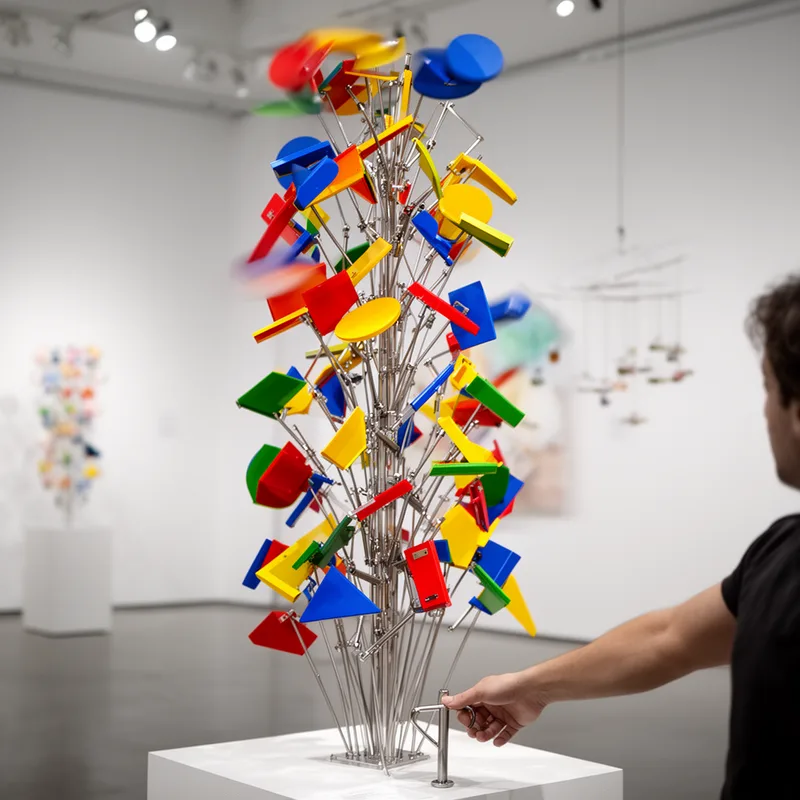
kinetic art
- noun
- /kɪˈnɛtɪk ɑrt/
- Specialized
 :
arte cinético
:
arte cinético
- Many visitors were captivated by the stunning kinetic art installations that created mesmerizing patterns as they spun.
Examples
-
While most likely well-intentioned, such associations inadvertently supported the argument that kinetic art was a spectacle that incapacitated rather than activated the spectator.
Academic text (2014) -
"The volunteer crew usually partners with artists who want to produce what Rukstela terms kinetic art that just so happens to involve steam engines."
Academic text (2009) -
"I simply thought I'd try using vintage equipment to run kinetic art," he said.
Academic text (2009) -
The repeated silence on Taeuber's image surely stems, in part, from the difficulty of discussing a kinetic art form from still-photo evidence; but it also signals a disciplinary blindness toward dance's cultural and historical significance.
Academic text (2014) -
The museum's latest exhibit showcases innovative pieces of kinetic art that move and change over time.
-
In her latest project, the artist explores kinetic art through sculptures that respond to the wind and viewer interaction.
Surface Forms
Morphology
The meaning is directly built from 'kinetic' (relating to motion) combined with 'art' (artistic work), so a learner who knows both words can infer 'art that involves movement'. This adjective+noun composition follows standard, cross-linguistically common patterns, making the phrase immediately comprehensible to B1 learners.
Etymology
Kinetic art comes from the word kinetic, which means 'movement'. Imagine sculptures that spin in the wind or pieces that move when you touch them, and you can see why kinetic art means art that actually moves or looks like it moves.

