
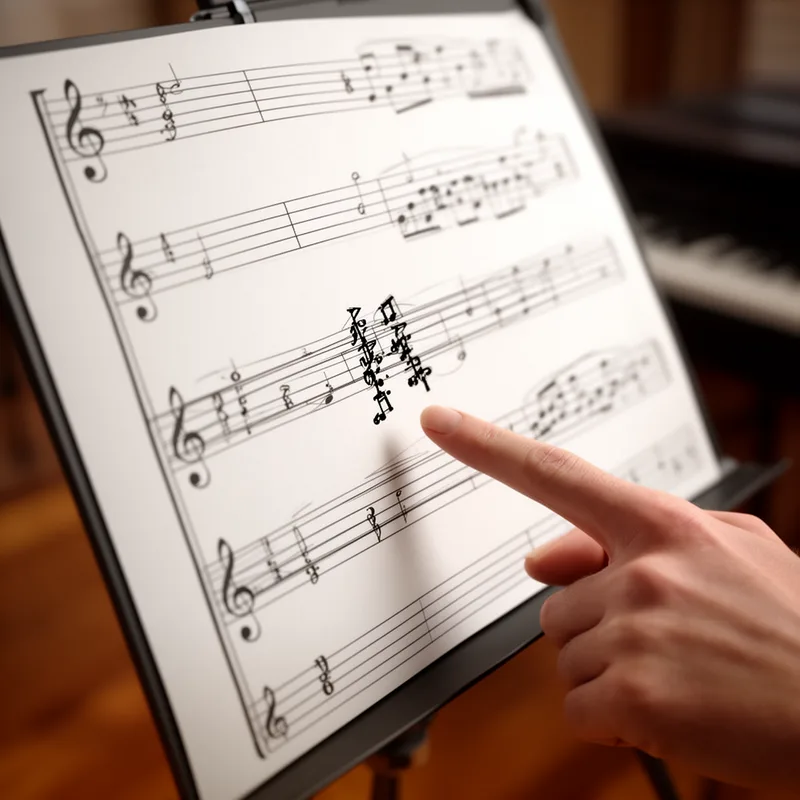
key signature
- noun
- /ki ˈsɪɡnətʃər/
- Specialized
- When you read music, the key signature tells you which notes are sharp or flat.
- minor key signature
- key signature with sharps
- key signature with flats
Examples
-
The easiest songs for beginning guitarists feature key signatures with sharps: G, D, A, and E major.
Academic text (2010) -
I looked at the key signature for F major.
Academic text (2001) -
I began thinking to myself, "There is no way that can work in all the sharp key signatures."
Academic text (2001) -
In written theory, they understand key signatures and closely related keys.
Academic text (2011) -
Ask questions about form, meter, key signature, mood, and style.
Academic text (2001) -
Work with students to find the key signature, time signature, composer, date, and starting pitch.
Academic text (2003) -
Let's look at the minor key signature with seven flats.
Academic text (2001) -
In addition, the same note can be written several different ways, depending on the key signature and accidentals.
Academic text (1997) -
Sharps appear in key signatures in a specific order, F#, C#, G# D sharp, A sharp, E sharp, B sharp.
-
To address this, the teacher directs the student's attention to the key signature and reminds the individual of the fingering for B-natural.
Academic text (2015)
Synonyms

 23
7.0
23
7.0

The sharps or flats written after a clef that show a piece's key
Surface Forms
Morphology
The compound is compositionally interpretable as ‘a signature belonging to or applied to a key’ so there is partial predictability from the parts. However, the meaning is domain-specific (cryptography) and conflicts with a common musical sense ('key signature'), so a B1 learner who knows only the basic constituent senses would likely be uncertain without background knowledge. This partial compositionality plus required specialist knowledge makes the MWE semi-transparent.
Etymology
Key signature: The musical term key signature comes from putting a small signature of sharps or flats at the start to show the key, the 'main notes' that are changed, so the mark tells musicians which scale to use.