
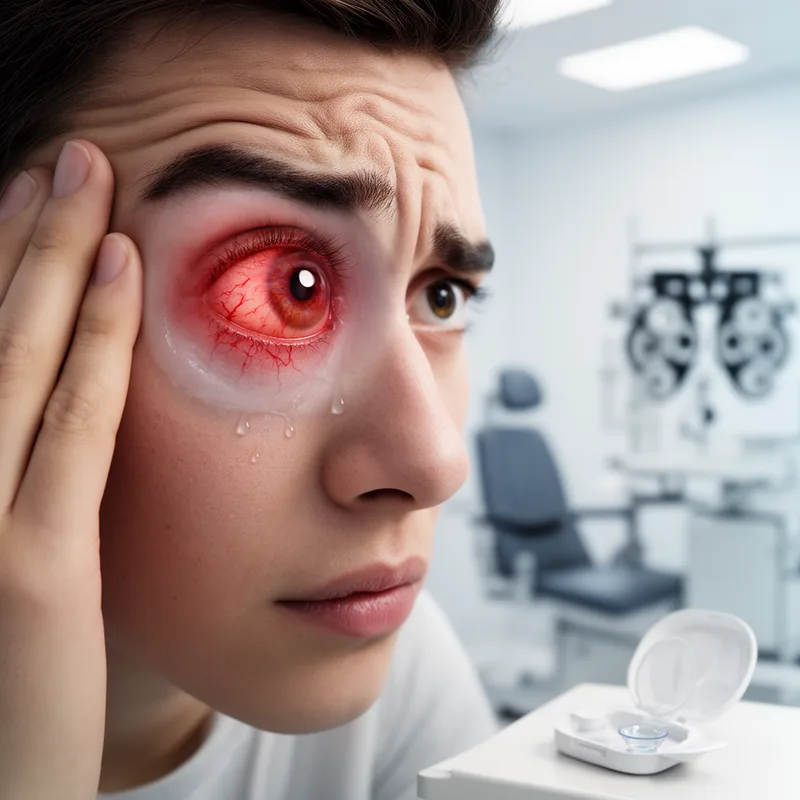
keratitis
 1
8.5
1
8.5

- noun
- /ˌkɛrəˈtaɪs/
- Specialized
- In 1945, Cogan described a syndrome of nonsyphilitic interstitial keratitis combined with a Meniere's-like complex of symptoms.
- interstitial keratitis
Examples
-
When another inflammatory lesion is present, in addition to or instead of interstitial keratitis, the condition is termed atypical Cogan's syndrome.
Academic text (1999) -
With regard to ophthalmologic disease, Pseudomonas aeruginosa is the most common cause of bacterial keratitis in patients with contact lenses.
Academic text (2005) -
Ophthalmologic evaluation was consistent with bilateral interstitial keratitis, which was greater in the right eye than in the left.
Academic text (1999) -
Quinolones have largely replaced the aminoglycosides as a topical therapy for keratitis during the past 10 years, and they are largely successful.
Academic text (2005) -
Rangers officials said that Hamilton saw an optometrist and was diagnosed with ocular keratitis, a drying of the cornea caused by too much caffeine.
Blog text (31) -
When a review of the patient's ophthalmologic examination revealed that he suffered from recurrent iritis and not interstitial keratitis or uveitis, the diagnosis of Cogan syndrome was questioned.
Academic text (2010) -
Mr. Wolfe, we understand that you have keratitis, which can cause pain and blurred vision.
-
The chances of contracting keratitis increase with each consecutive night of wearing contact lenses.
-
These microorganisms can cause keratitis, which may result in redness and damage to the cornea.
Synonyms

A disease of the clear front part of the eye that harms vision
How Inflamed

Surface Forms
Morphology
keratitis = kerat- (opaque) = kerat + itis
The base 'kerat-' is not a standalone English word and '-itis' is a specialized medical suffix, making the formation opaque for most learners.
Etymology
Keratitis comes from a Greek root keras meaning 'horn', because the clear front of the eye, the cornea, was once thought to be like a horn or hard cover. So keratitis is the name for when that front part of the eye becomes inflamed, causing pain, redness, and blurred vision.