
keratin
 4
6.6
4
6.6

- noun
- /ˈkɛrətɪn/
- Specialized
- - We'll show him the keratin analysis first.
- keratin debris
- molecular-weight keratin
- high-molecular-weight keratin
Loading YouTube…
Watch on YouTubeAnd the nail thing, I guess it would just be keratin, right?
- And the nail thing, I guess it would just be keratin, right?
- And those are the K tips, the keratin bond tips.
- This is the Vaseline intensive care healthy hands, stronger nails with keratin hand cream.
- Argan oil, sulfate free volume, shine Hairspray, extra hold, fast drying, infused with keratin.
Examples
-
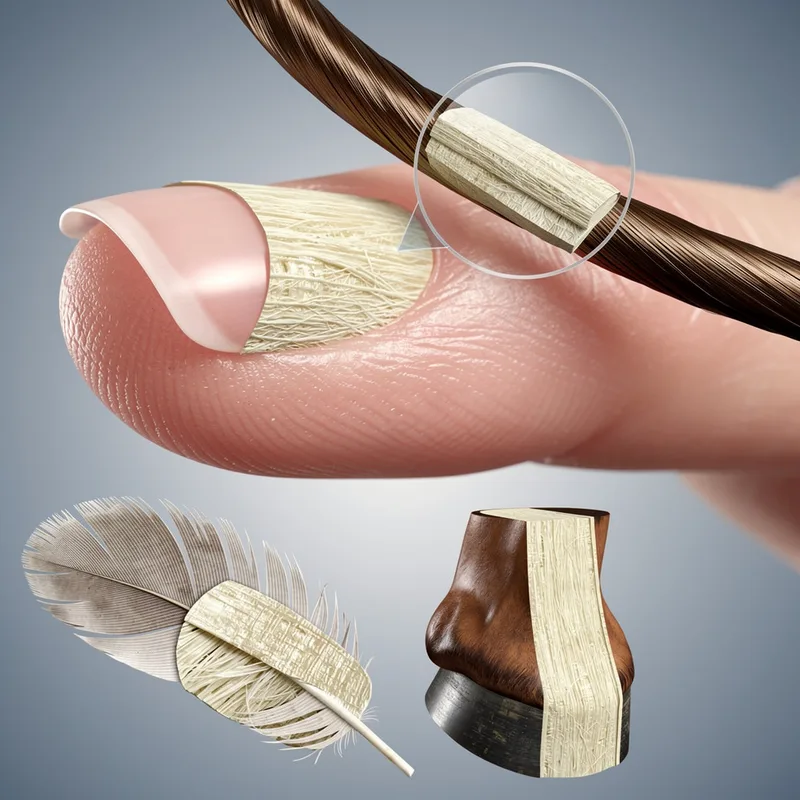
They are composed largely of keratin, and so the same protein that, for example, makes up our nails or our hair.
-
The middle ear must be free of keratin debris.
Academic text (2006) -
We do not know how the keratin reached the ear.
Academic text (2003) -
Poultry feathers contain 90% of their total weight as keratin, which gives the material its characteristic light but rigid structure.
Academic text (2018) -
Most of these reptiles have thick scales covered in keratin, the same material that makes up nails and claws.
-
The rattle consists of hollow, interlocked segments made of keratin, the same substance that makes our nails and hair.
-
Unlike deer, pronghorn have forked horns made of keratin, not antlers, which are bone.
Academic text (2007) -
The final pathology report identified the mass as keratin debris with focal acute inflammatory exudate.
Academic text (2006) -
Photomicrograph of the cholesteatoma shows stratified squamous epithelium and overlying lamellar sheets of keratin (H&E, original magnification x 10).
Academic text (2009) -
Nails are unique structures formed of keratin, just like hair and the superficial skin layers.
Surface Forms
Morphology
keratin = kerat + in
Formed from the combining form 'kerat-' (not a standalone English word) plus the protein-forming suffix '-in', producing a specialised scientific term that an average B1 learner cannot derive from known English words.
Etymology
The word keratin comes from the Greek word keras, meaning 'horn'. That is a helpful image because keratin is the tough protein that makes horns, hair, nails and feathers, so thinking of 'horn' helps you remember it is a hard, protective material.