
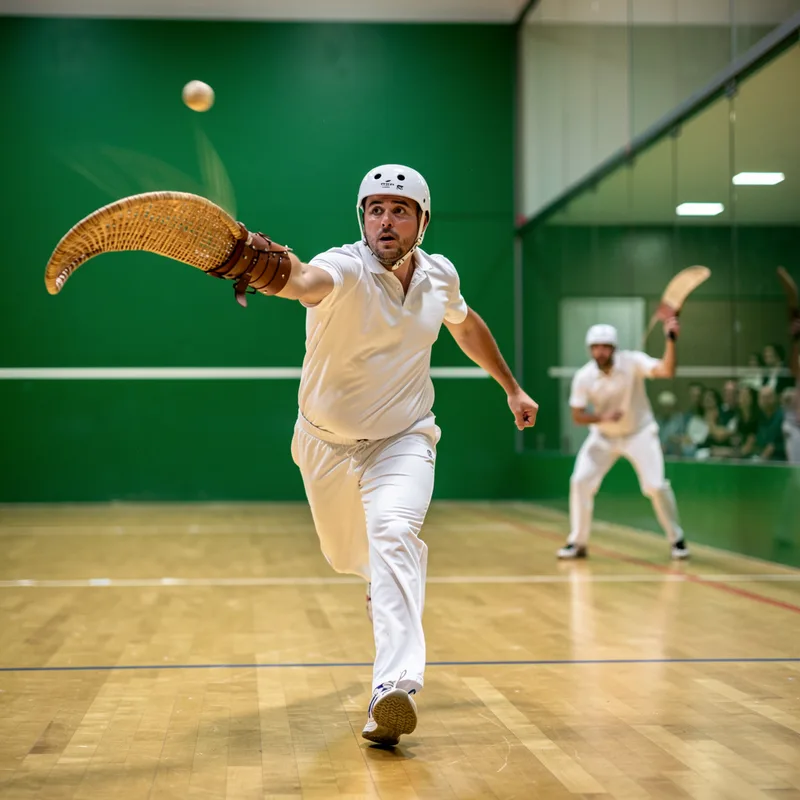
jai alai
 2
9.9
2
9.9

- noun
- /ˈhaɪ əˈlaɪ/
 :
jai alai
:
jai alai
- Swimming and basketball meets for women took place, bullfights and horse races were held, and construction began on the new Fronton Nacional (stadium for jai alai).
- jai alai players
Examples
-
Jai alai and bullfighting existed as spectator sports dominated by foreign (Spanish, in this case) professionals, but they also presented opportunities for participation by amateurs.
Academic text (1994) -
The jai alai exhibition was canceled at the last minute due to the illness of one of the Cuban players.
Academic text (1994) -
I lose all my money at the jai alai.
-
Amigo, I lost all my money in the Jai Alai.
-
I did every sport you can imagine—field hockey, tennis, jai alai.
Fiction book (1991) -
One day, Felipe here is a champion jai alai player, and the next, he's hurling grenades instead of pelotas.
-
At the festival, the crowd cheered as the players showcased their impressive skills in jai alai matches.
-
During my visit to Florida, I enjoyed watching a jai alai game that featured thrilling fast-paced action.
-
He often placed bets on jai alai games, hoping to win big while enjoying the excitement of the sport.
Synonyms
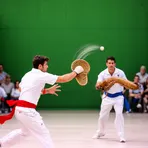
A fast Basque court game in which players hit a small ball with their hand or a wicker racket
Surface Forms
Morphology
jai + alai
The term is a Basque loan/name for a specific sport and its constituent parts are not English words with transparent meanings for learners (dictionary entries are missing). Because the overall sense (a particular ball game played with a cesta) cannot be deduced from the pieces by a B1 learner, the expression is idiomatic/lexicalized and therefore opaque.
Etymology
Jai alai comes from two Basque words: jai meaning 'festival' and alai meaning 'merry'. The game was often played at village festivals, so the name stuck and today jai alai means the fast Basque 'ball game' played with a curved basket.