
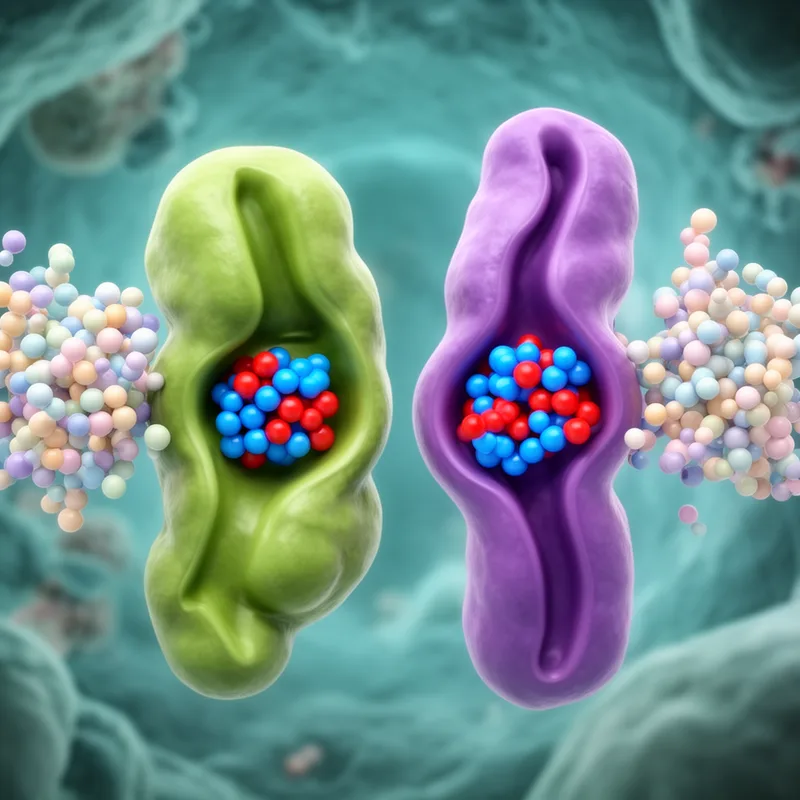
isozyme


 1
9.9
- noun
- /ˈaɪzoʊˌzaɪm/
- Specialized
- Only a few isozyme variants were detected in the samples, indicating limited diversity within the population.
Examples
-
Male germ cells produce testis ACE, an isozyme of ACE, which is smaller than the somatic form, as it contains only the carboxy-terminal domain.
Academic text (2018) -
Assuming that different genes should produce slightly different enzyme products, Gottlieb concluded that polyploids should have more isozymes (more gene products) than diploids.
Academic text (2002) -
An isozyme that has two or more allozymes at a frequency greater than 5% is said to be polymorphic.
Academic text (2002) -
Indirect procedures often use electrophoresis to analyze the distribution of isozyme variants within and between populations.
Academic text (2002) -
Analyses of isozyme studies have provided additional information about the sporophyte products of gametophyte breeding systems.
Academic text (2002) -
Prior to the development of isozyme databases, the information regarding breeding systems in homosporous plants came from laboratory studies of gametophytes.
Academic text (2002) -
The availability of databases charting isozyme variation for pteridophytes provided another opportunity for considering the unique genetic features of homosporous plants.
Academic text (2002) -
In most cases, surveys of seed plants have upheld this assumption (but see Elisens and Crawford 1988), and thus have led to the application of isozyme evidence in determining ploidy levels in plants.
Academic text (2002) -
Structurally (chemically) different yet functionally similar enzymes are called isozymes, and using the technique of electrophoresis, it is possible to detect the different forms of the enzymes present in cells.
Academic text (2002) -
Researchers identified an isozyme that plays a critical role in the bacteria's ability to metabolize glucose.
Synonyms
 2
9.1
A slightly different version of a protein made from the same gene that works in a similar way
 1
8.1
A slightly different form of an enzyme that does the same job in the body
Surface Forms
Morphology
isozyme = enzyme (semi-transparent) = iso + zyme
The prefix 'iso-' (same) plus the base 'enzyme' give a clear sense of similarity, but the precise technical meaning (same function but different structure) is specialized and not fully predictable to a general B1 learner; note that 'isozyme' is a clipped form of 'isoenzyme'.
Etymology
The word isozyme comes from Greek parts iso- meaning 'equal' and zyme, seen in enzyme, which refers to a substance that speeds up a reaction. So an isozyme is an 'equal enzyme' — it does the same job as another enzyme even though it has a different structure or form.