
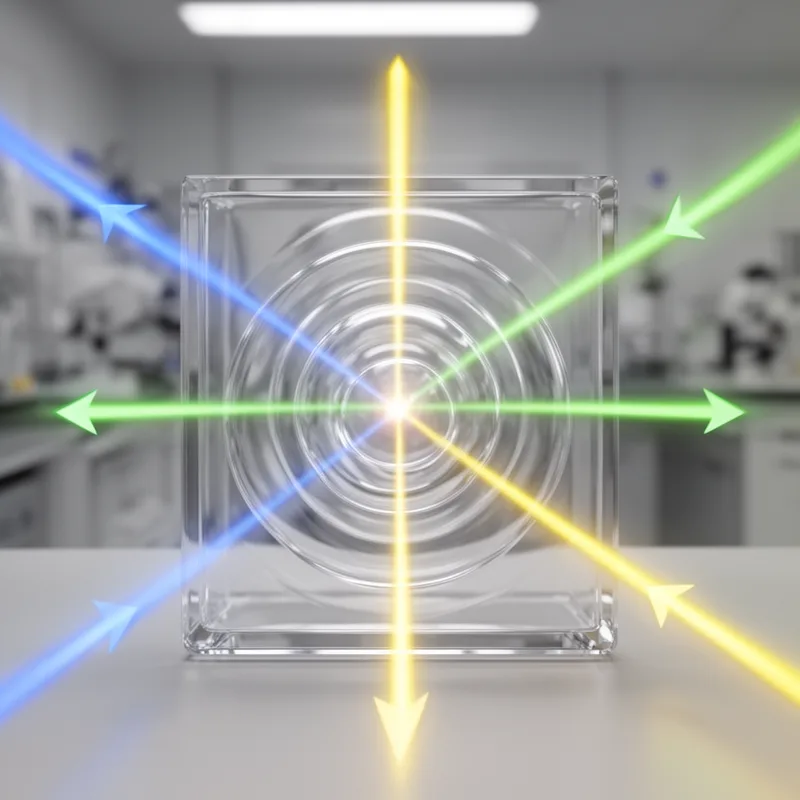
isotropic
 1
8.9
1
8.9

- adjective
- /ˌaɪsəˈtrɒpɪk/
- Specialized
 :
isotrópico
:
isotrópico
- When analyzing the behavior of sound waves, it is essential to work with isotropic materials to ensure uniform transmission in all directions.
- homogeneous and isotropic
- elastic and isotropic
- isotropic material
But he didn't understand how to get an isotropic distribution of population.
- But he didn't understand how to get an isotropic distribution of population.
- The air in this room is largely homogeneous and isotropic.
- Turns out not to be true, that even very close to the wall, the distribution of velocities is still pretty isotropic.
- It's isotropic must have been isotropic very early.
Examples
-
In the outer solar system, the Oort cloud of comets is thought to be isotropic.
Academic text (1996) -
And so it is an isotropic medium bar none.
-
"Once the cloud runs over us, the radiation is isotropic."
Fiction book (2001) -
Go a bit further out, and the halo around our galaxy is isotropic.
Academic text (1996) -
In the model, the tissue was assumed to be linear, elastic, and isotropic.
Academic text (1994) -
In general, these materials have been modeled as linear and nonlinear elastic isotropic materials.
Academic text (1996) -
Short discrete fibers mixed uniformly within the soil mass can provide an isotropic increase in the strength of reinforced soil.
Academic text (2016) -
The material is classified as isotropic because its properties remain consistent regardless of the direction in which they are measured.
-
In an isotropic universe, the same physical laws apply uniformly in every direction, allowing for a balanced distribution of matter.
Synonyms

Having the same properties in all directions

Not aimed in any one direction
Antonyms


How Isotropic
92
3.7

- Specialized
1
8.9
- Specialized
16
5.3
- Specialized
 1
9.9
1
9.9
Surface Forms
Morphology
Etymology
Isotropic comes from Greek parts iso- meaning 'equal' and -tropic meaning 'direction' or 'turn'. You can see the iso- part in familiar science words like isotope. So an isotropic material has 'equal' properties in every direction, which is why it behaves the same no matter which way you look at it.