
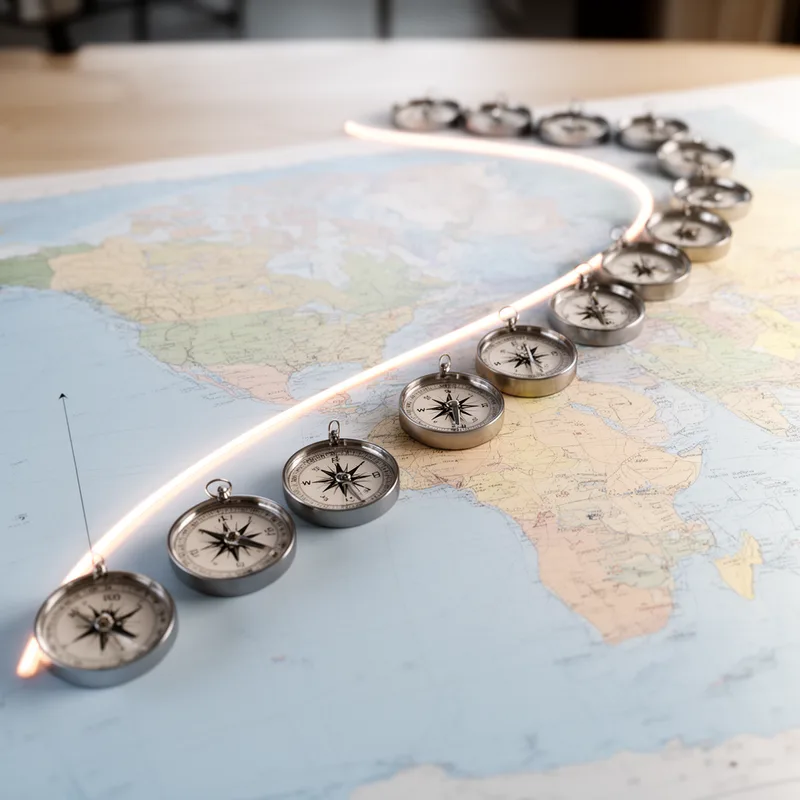
isogone
- noun
- /ˈaɪzəˌɡoʊn/
- Specialized
- Researchers updated charts to reflect shifts in the isogone over the last decade.
Examples
-
The navigator traced the isogone on the map to account for magnetic variation.
-
Crossing the isogone indicates a change in the magnetic declination experienced by compasses.
-
The isogone indicates areas of equal magnetic declination.
-
On the map, the isogones are clearly marked.
-
The navigator traced the isogone on the map to account for magnetic variation.
-
Crossing the isogone indicates a change in the magnetic declination experienced by compasses.
-
Researchers updated charts to reflect shifts in the isogone over the last decade.
Synonyms
A line on the Earth's surface joining places where compasses point the same amount from true north
A line on a map connecting places with the same difference between magnetic north and true north

A line on a map that joins places with the same height or temperature

A line on a map joining places that have the same temperature or height

A line on a map that connects points with the same value, like temperature

A line on a map that connects places with the same value, like temperature

A line on a map connecting points that have the same value, like temperature or pressure
Surface Forms
Morphology
isogone = iso + gon
Formed from Greek combining elements 'iso-' and '-gon', which are technical combining forms rather than familiar English words, so learners cannot reliably derive the specialised meaning from common vocabulary.
Etymology
Isogone comes from the parts iso- 'equal' and -gon 'angle', the same root you meet in polygon. It names a line on the Earth where a compass shows the same angle, so it is a line of 'equal' magnetic direction.

