
isogon
- noun
- /ˈaɪsəˌɡɒn/
- Specialized
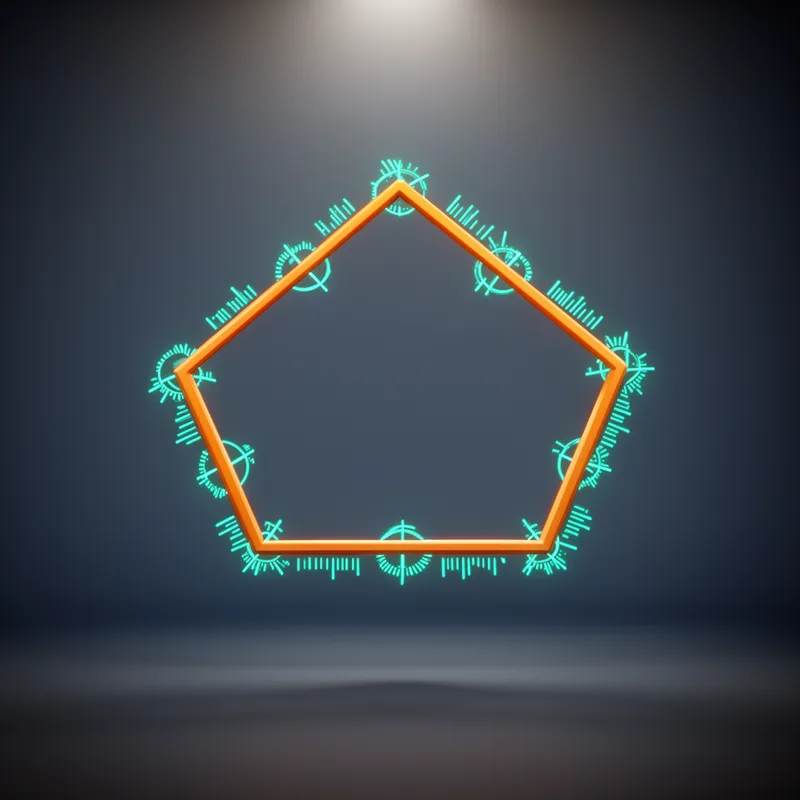
- An isogon need not have sides of equal length, only equal interior angles.
Examples
-
A regular hexagon is a type of isogon because all its angles are equal.
-
A regular pentagon is an isogon.
-
The mathematician studied a rare isogon with unequal sides but congruent angles.
-
An isogon has equal angles.
-
A regular hexagon is a type of isogon because all its angles are equal.
-
An isogon has equal angles, regardless of the length of its sides.
-
The mathematician identified a unique isogon that had all angles measuring 120 degrees.
Surface Forms
Morphology
isogon = gon (semi-transparent) = iso + gon
Composed of technical combining forms 'iso-' (equal) and '-gon' (angle), which are logical but specialized and may be unfamiliar to average learners.
Etymology
Isogon comes from the Greek parts iso- meaning 'equal' and -gon meaning 'angle', the same -gon you see in hexagon and polygon. So an isogon is a shape with 'all angles equal', which is why it means a polygon whose angles are the same.

