
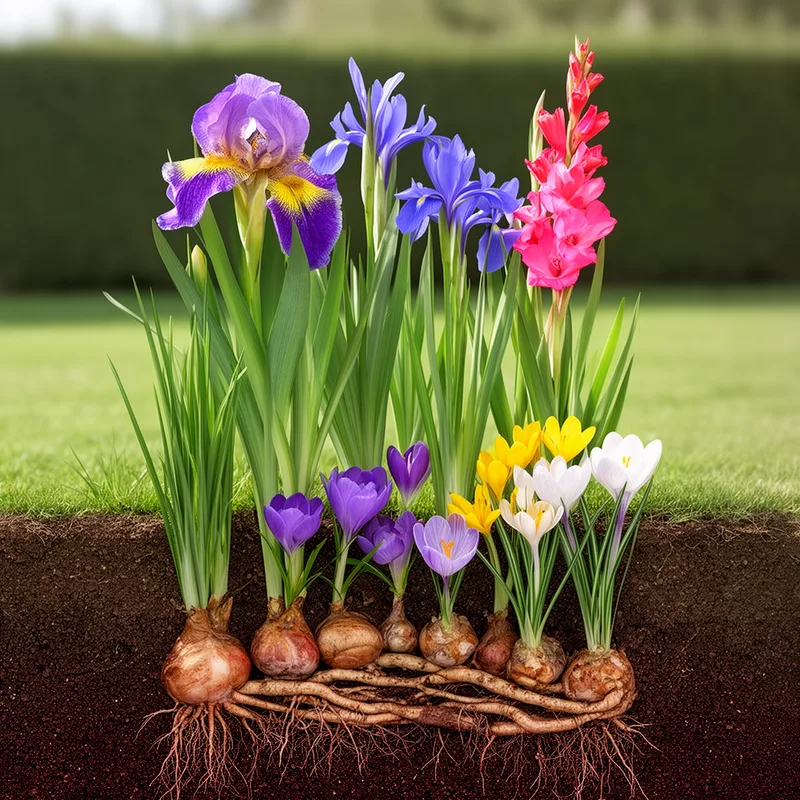
iris family
- noun
- /ˈaɪrɪs ˈfæmɪli/
- Specialized
- Gardeners often choose plants from the iris family for their vibrant colors and resilience.
Examples
-
The beautiful blue and purple flowers of the iris family bloom in spring.
-
The iris family includes several species that thrive in wetlands and disturbed areas.
-
Among the wildflowers are yellow star grass of the iris family, brookweed of the primrose family, Indian plantain of the aster family, as well as Saint Johnswort and lizard's-tail.
Academic text (1993)
Synonyms

A group of flowering plants like irises that grow from bulbs or roots
A group of flowering plants like irises and crocuses that often grow from bulbs or thick underground stems
Surface Forms
Morphology
The meaning is directly compositional: 'iris' (the flower) combined with 'family' (a grouping of related species) yields 'the family of plants that includes irises,' which follows standard taxonomic noun + noun/grouping patterns. This construction is cross-linguistically common and thus a B1 learner who knows both constituents should be able to infer the MWE meaning.
Etymology
Iris family is named after the flower iris, which in turn was linked to Iris, the Greek messenger of the rainbow, because these flowers come in many bright colors. So iris family means a 'group of related plants' such as crocuses and gladioli that share similar colorful blooms and sword-shaped leaves.

