
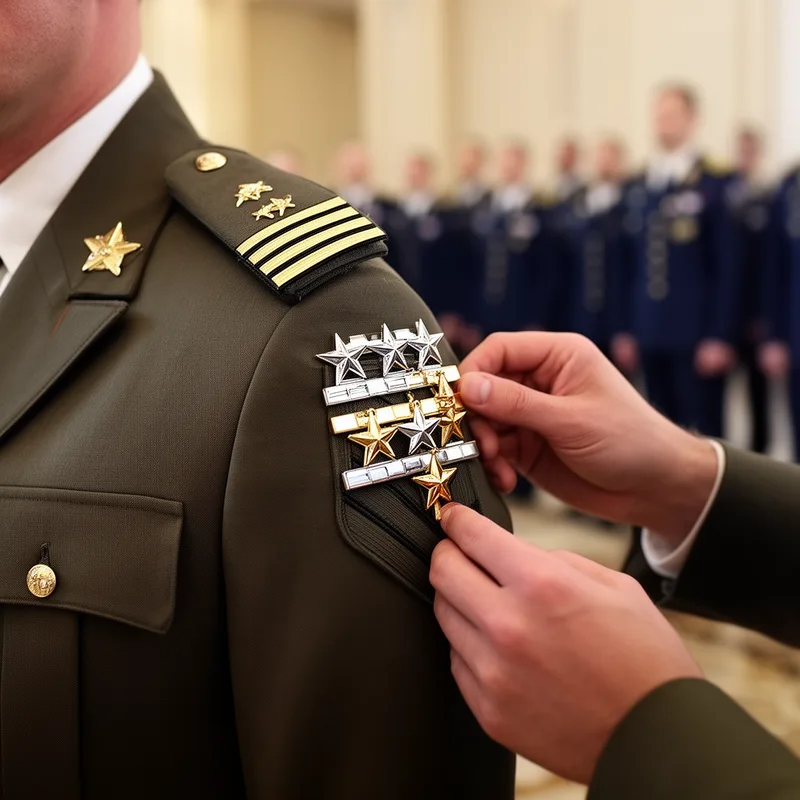
insignia of rank
- noun
- /ɪnˈsɪɡniə əv ræŋk/
- Sinklar wore no insignia of rank, no fine fabrics, just the armor of the common soldier.
- wear insignia of rank
Examples
-
For example, Quintana is tried by a mock military court; gang members all wear symbols and insignia of rank. They also adopt the vocabulary of antifascism, which they neither understand nor question, and they use the term faccioso to define the enemy.
Academic text (1990) -
In most units, North and South alike, officers commonly wore outfits like those of their men, but for insignia of rank, the better to avoid drawing the enemy's eye to them.
Fiction book (1992) -
A soldier wearing four pockets on his jacket, the most common insignia of rank in the People's Liberation Army, trotted uphill.
Fiction book (2001) -
He was in full dress, but wore no insignia of rank.
-
Sinklar wore no insignia of rank, only the normal attire of a soldier.
-
In the military parade, each officer displayed their insignia of rank proudly on their uniforms.
Synonyms
 41
3.2
41
3.2

A narrow band on a uniform showing a person's military rank or years of service
 25
7.1
25
7.1
A badge worn to show official rank or group membership
 10
4.9
10
4.9
A V-shaped badge on a uniform sleeve that shows a person's rank or how long they served
 1
4.2
1
4.2
A cloth badge on a uniform shoulder showing rank or group
A small cloth or badge on the shoulder of a uniform that shows rank

A V-shaped badge on a sleeve that shows a military person's rank and years of service
How Visible
- Jargon
1
6.8

- US
4
9.3
3
6.6
41
3.2
153
1.0
Surface Forms
Morphology
The meaning is directly and transparently derived from combining 'insignia' (a badge or emblem) with 'rank' (a level of authority), with 'of' indicating association; a B1 learner who knows both constituents will readily infer it denotes a badge showing someone's rank. The noun + of + noun compositional pattern is common in English and cross-linguistically, so the expression is immediately comprehensible from its parts.
Etymology
Insignia of rank comes from the old practice of putting small symbols, like stars or stripes, on a uniform shoulder so everyone could see a soldier's rank. These visible insignia showed who was in charge, so today the phrase means a badge or symbol worn to show 'rank'.