
inner product


 1
8.0
1
8.0
- noun
- /ˈɪnər ˈprɒdʌkt/
- Specialized
- In linear algebra, the inner product provides a way to measure the similarity between vectors.
Loading YouTube…
Watch on YouTubeIn my definition, the simplest predicate is function function, and you can use this function to make inner product lattice predicate.
- In my definition, the simplest predicate is function function, and you can use this function to make inner product lattice predicate.
Examples
-
Inner product (dot product) computation and finding the maximum or minimum of a vector are examples of reduction operations.
Academic text (1994) -
To find the angle between two vectors, we use the inner product to calculate the cosine of the angle.
-
Look at it, the inner product of A with itself.
-
Now let's take the inner product of both of these equations.
-
It's called the inner product or the scalar product.
-
The formula for the inner product of two vectors involves multiplying their corresponding components and summing the results.
Synonyms

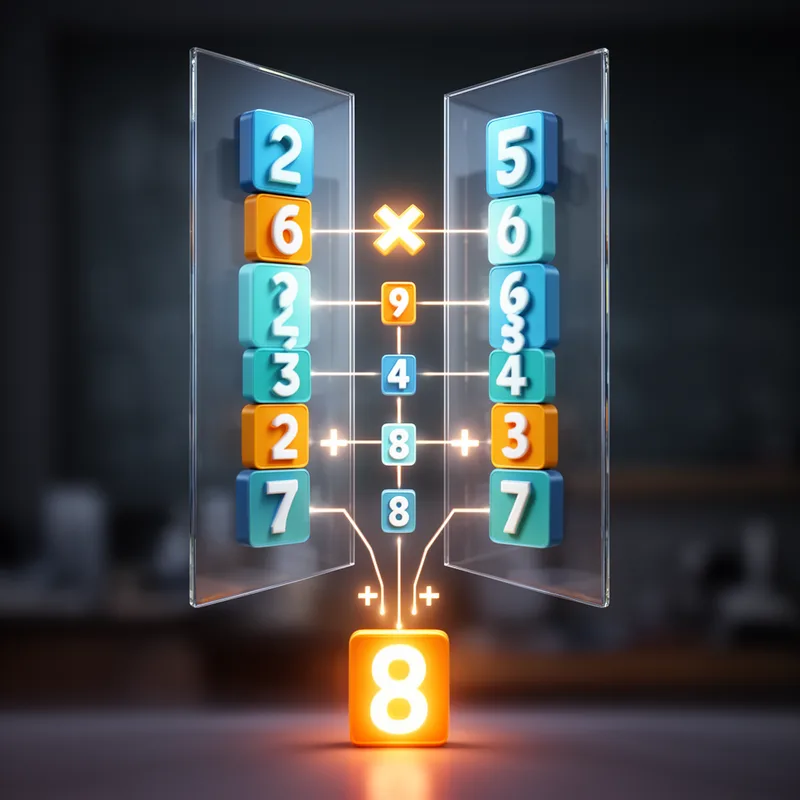
A number made by multiplying pairs of numbers from two lists and adding them

A single number you get by multiplying pairs of numbers from two vectors and adding them
Surface Forms
Morphology
The parts 'inner' (inside/within) and 'product' (result of multiplication) give a partial clue: the expression refers to a multiplication-like operation between components of vectors. However, the precise mathematical meaning (the dot/sum-of-products operation on vectors) is specialized and not fully predictable from the words alone for an average B1 learner, so it is only partially transparent.
Etymology
The term inner product comes from a simple image: take two arrows or lists of numbers, multiply each matching pair (the product) and then add those results that come from the 'inner' parts of the arrows (the inner). This gives a single 'number' that shows how much the two arrows point the same way, so the phrase means a way to get a number from two lists or arrows.