
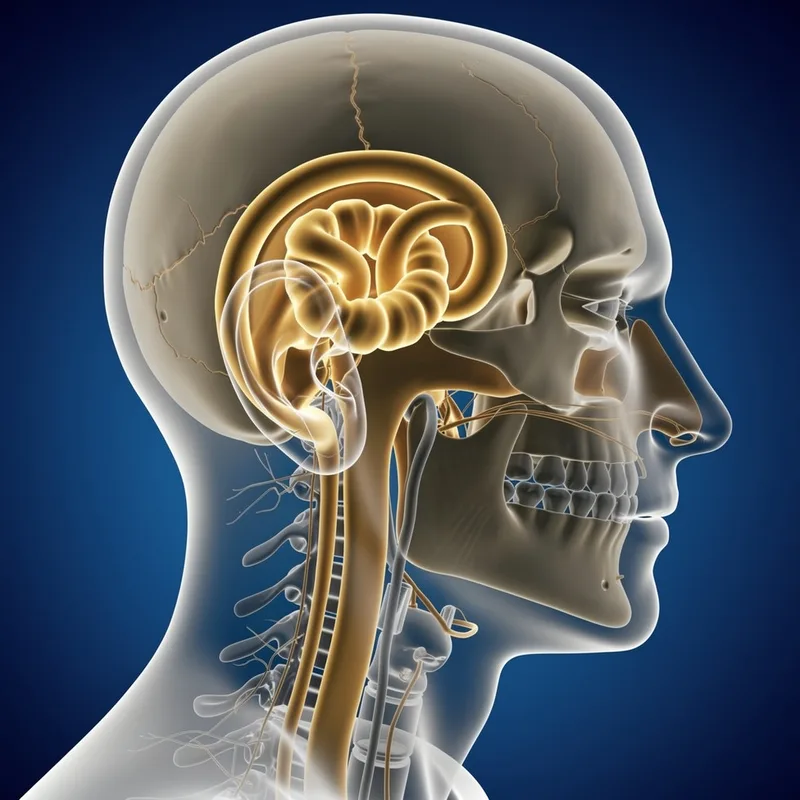
inner ear
 14
4.1
14
4.1

- noun
- /ˈɪnər ɪr/
- Specialized
- When sound waves reach our ears, they travel into the middle and inner ear where there are these things called hair cells.
- inner ear fluid
- inner ear trauma
- inner ear disorder
Loading YouTube…
Watch on YouTubeSo your inner ear consists of these three like fluid filled tubes, right?
- So your inner ear consists of these three like fluid filled tubes, right?
- OK, so this snail shaped structure in your inner ear is where sound gets converted into electrical signals that the brain can understand.
- Because if you tilt your head too fast, your inner ear has no idea what's going on, and things go wrong very quickly.
- Yeah, I've inner ear problems for, like, my equilibriums.
- The major part of the brain, the cerebellum, is wired primarily into the inner ear.
- It can capture sound and turn the sound into patterns of vibration on the skin from high to low frequency, which is exactly what the inner ear does.
Examples
-
OK, so this snail shaped structure in your inner ear is where sound gets converted into electrical signals that the brain can understand.
-
The three semi-circular canals in your inner ear help maintain your sense of balance.
-
Despite such a vulnerable condition, no inner ear damage was found in all but two animals in this study.
Academic text (1998) -
A new procedure for delivering medication directly to the inner ear has been developed.
Academic text (1999) -
The part of the inner ear that has to do with hearing is called the cochlea.
Academic text (1990) -
When an individual is overexposed to excessive sound levels, sensitive structures of the inner ear can be damaged.
Academic text (2008) -
The two main parts of the inner ear are the semicircular canals and the cochlea.
Academic text (1990) -
The stapedial reflex is best known for its role in protecting the inner ear from acoustic trauma.
Academic text (1998) -
Damage to the inner ear can lead to difficulties in hearing and maintaining balance.
-
The tiny hair cells in the inner ear are essential for transmitting sound to the brain.
Synonyms


 1
8.4
1
8.4
Small connected spaces in the inner ear that help a person hear and keep balance

The part of the ear inside the head that helps you hear and keep balance
How Deep

Surface Forms
Morphology
The noun phrase is clearly compositional: 'inner' (inside/nearer the center) + 'ear' (hearing/balance organ) yields the innermost part of the ear. This is a direct, cross-linguistically common spatial/partitive combination, so a B1 learner who knows both words can reliably infer the meaning.
Etymology
Inner ear is the name for the part deep inside the ear. The word inner shows it is 'inside' where tiny parts help us hear and keep our balance, so the name means the hidden system that controls hearing and balance.