
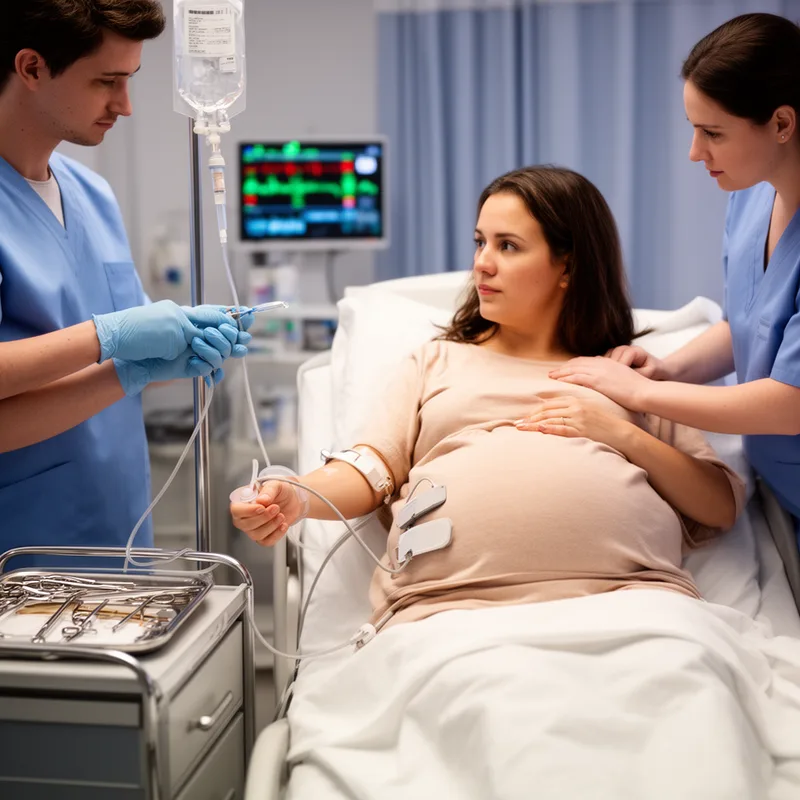
induction of labor


 1
4.1
1
4.1
- noun
- /ɪnˈdʌkʃən əv ˈleɪbər/
- Specialized
 :
inducción del parto
:
inducción del parto
- Artificial induction of labor doubles the risk of surgical birth in first-time mothers.
Examples
-
A 32-year-old primigravida was admitted at 40 weeks' gestation for induction of labor following amniorrhexis.
Academic text (2003) -
The second procedure is early induction of labor.
Blog text (11) -
Artificial induction of labor
Blog text (9) -
Through this study, it has been noted that it is not the drug (ethacridine lactate) but the fluid that is important for successful induction of labor.
Academic text (2007) -
Suspected fetal macrosomia is not an indication for induction of labor, because induction does not improve maternal or fetal outcomes.
Blog text (24) -
Elective induction of labor and labor analgesia is advisable in such high-risk patients for better planning, hemodynamic monitoring, and availability of expert personnel during labor.
Academic text (2007) -
The doctor recommended an induction of labor to ensure a safe delivery for both mother and baby.
-
After discussing the risks and benefits, she agreed to the induction of labor to avoid complications.
-
During the appointment, the midwife explained the process involved in the induction of labor and what to expect.
Antonyms
 4
4.0
4
4.0
Giving birth with little medical help and no drugs to reduce pain or help the birth
How Invasive

Surface Forms
Morphology
The meaning is directly compositional: 'induction' = initiation or triggering, and 'labor' = childbirth contractions, so 'induction of labor' literally denotes initiating childbirth. This construction is transparent and cross-linguistically common (e.g., Spanish 'inducción del parto'), so a learner who knows the constituents can infer the meaning.
Etymology
Induction of labor comes from the words induction, meaning making something start, and labor, meaning childbirth. Imagine a doctor giving medicine or breaking the water to make the mother's body begin to push. That's why it means 'artificially starting childbirth'.