
induction motor
- noun
- /ɪnˈdʌkʃən ˈmoʊtər/
- Specialized
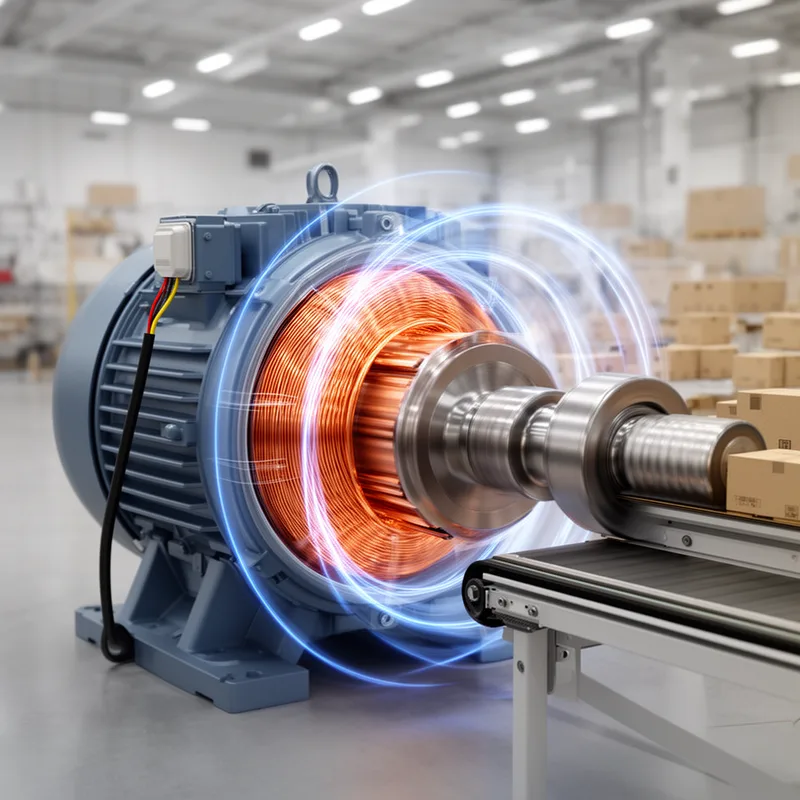
- Many EVs run on induction motors, which have two main parts, a stator and a rotor.
- AC induction motor
- pole induction motor
Examples
-
Typically, a four-pole AC induction motor operates between 1450 and 1650 RPM and hits peak efficiency at around 1550 RPM.
Academic text (1995) -
Outside its practical operating range, the induction motor's efficiency and torque-generating ability drop dramatically.
Academic text (1995) -
Well, for that the proposal and indeed the result is to use an induction motor, a linear induction motor.
-
If I've got a large machine like an induction motor, it's going to have an equal load on each each of its three phases.
-
Generally, induction motors are as reliable as brushless motors.
Academic text (1995) -
In many supermarkets, more than 200 induction motors rotate constantly in the effort to keep food fresh.
Academic text (1995) -
The vector drive controller at Greenville Tube monitors the current, voltage, and position of the AC induction motor.
Academic text (2001) -
AC induction motor (right) can acquire speed and torque control by operating through a flux vector drive.
Academic text (2003) -
Each MOPICO unit includes a GEC Alsthom two-pole induction motor with centrifugal compressor impellers mounted on the extended ends of the motor rotor.
Academic text (1996) -
In many supermarkets, more than 200 induction motors rotate constantly in the effort to keep food fresh.
Synonyms

A motor that runs on alternating current and turns by a changing magnetic field
Surface Forms
Morphology
The compound is fully compositional: 'induction' (generation of electrical current via changing magnetic fields) plus 'motor' (device converting energy into motion) yields a motor that operates by electromagnetic induction. This noun‑noun formation follows a standard, predictable pattern so a learner who knows both constituents can infer the MWE meaning.
Etymology
Induction motor is named after induction, which means a moving magnetic field makes electricity appear in another part. In this motor a spinning magnet in the outside part, the stator, makes electricity appear in the inner part, the rotor, so the rotor turns 'without wires' and that is why it is called an induction motor.

