
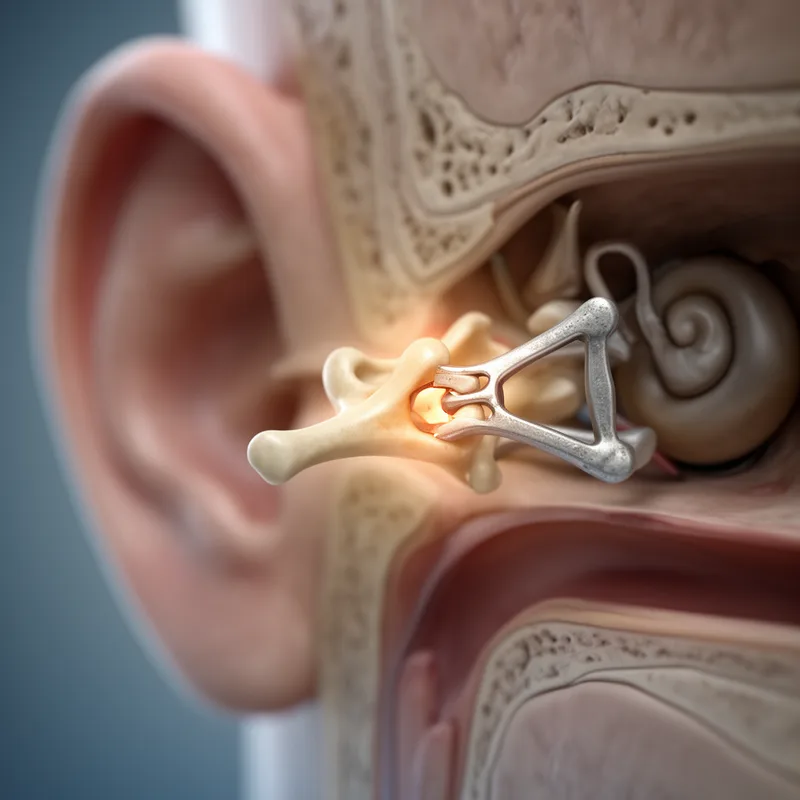
incudostapedial
- adjective
- /ˌɪnkjʊdoʊsteɪˈpiːdiəl/
- Specialized
- The anatomy of the middle ear includes the incudostapedial joint, which connects two important bones for sound transmission.
- incudostapedial joint
Examples
-
The most common types of ossicular injury in these cases are dislocation of the incudostapedial joint, fracture of the stapes, and subluxation of the stapes footplate.
Academic text (2005) -
The most common finding in such ossicular injuries is incudostapedial joint separation, which occurs in 53 to 82% of cases.
Academic text (2005) -
This measurement was made after the incudostapedial joint was divided and the crura of the stapes were removed.
Academic text (1998) -
The other style mounts inferiorly to the incudostapedial joint but clips directly to the long process of the incus.
Academic text (1998) -
At this stage, I make one or two laser hits on the incudostapedial joint for hemostasis to prevent any mucosal oozing or bleeding.
Academic text (1995) -
Because of the atraumatic removal of this bony fixation, the incudostapedial joint does not have to be disarticulated in the middle ear space.
Academic text (1995) -
In order to prevent trauma to the inner ear, the incudostapedial joint needed to be separated through a posterior tympanotomy prior to the removal of the incus.
Academic text (2005) -
A simple mastoidectomy via a facial recess approach was performed on all the bones, and a precision gauge was used to measure the force necessary to disrupt the weakest link in the chain (the incudostapedial joint).
Academic text (1998) -
Next, using the same temporal bone on the same day, vibrations of the ossicular chain were produced by the electromagnetic coupling of the coil with the implant placed at the incudostapedial joint.
Academic text (1998) -
Instead, a transmastoid transfacial recess (posterior tympanotomy) approach was used to separate the incudostapedial joint with an argon laser prior to incus removal.
Academic text (2005)
Surface Forms
Morphology
Etymology
Incudostapedial comes from the names of two tiny ear bones: incus meaning 'anvil' and stapes meaning 'stirrup'. So, incudostapedial describes the joint between the 'anvil' and the 'stirrup' in the middle ear, the connection that helps pass sound to the inner ear.

