

inclined fault
- noun
- /ɪnˈklaɪnd fɔlt/
- Specialized
- Earthquakes are often associated with the movement along an inclined fault beneath the surface.
Examples
-
The survey revealed multiple inclined faults crossing the valley.
-
During their hike, they observed the inclined faults that indicated past tectonic activity.
-
The geologist explained that the mountain range was formed by an inclined fault.
-
The inclined fault caused significant geological shifts.
-
Many inclined faults are found in mountain ranges.
-
The geologist pointed out that the inclined fault had created a dramatic cliffside along the landscape.
-
Research showed that the inclined fault was responsible for the recent earthquake in the region.
Synonyms

 63
6.1
63
6.1

A crack in the earth's crust where the ground has moved


 1
8.1
1
8.1
A break in rocks where the top part moves up over the lower part
 1
5.0
1
5.0
A crack in the Earth's crust where rock layers move
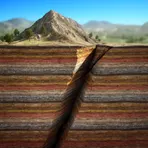
A break in rock where one side moves up when the land is pushed together

A break in rock where strong sideways force pushes one rock layer up and over another
Surface Forms
Morphology
The phrase is a straightforward composition: 'inclined' (tilted/sloping) modifies 'fault' (a tectonic fracture), so the MWE simply denotes a sloping/angled geological fault. Although somewhat technical, the meaning is directly derivable from the constituent words and follows regular adjective + noun composition, making it clear to learners who know both constituents.
Etymology
Inclined fault comes from a simple picture: a fault is a 'break' in the rock and inclined means it 'tilts' or 'slopes', so one side can 'move up' over the other. That's why an inclined fault means a tilted fracture in the ground where rock has shifted along a slope, often causing earthquakes or lifting mountains.