

illuminant


 1
8.4
1
8.4
- noun
- /ɪˈluːmɪnənt/
- Specialized
- The artist chose a warm illuminant to enhance the colors in her paintings.
- change of illuminant
Examples
-
Use the same illuminant to light the image, print, and display.
Academic text (1992) -
The experiment was conducted under standard illuminant D65 in a Macbeth Spectralight box.
Academic text (2006) -
Now change the illuminant in three ways:
Academic text (1992) -
The illuminant is another important factor one must take into account when considering metamerism.
Academic text (1992) -
The perceived color changes for each illuminant change are summarized in the table on page 55.
Academic text (1992) -
One must be able to control the illuminant's intensity and spectrum.
Academic text (1992) -
Consider an experiment using a variable illuminant, a high-quality scanner, a printer, and a display:
Academic text (1992) -
For accurate color matching, it's essential to use the same illuminant throughout the display.
-
In the lab, they tested different illuminants to see how light affects the appearance of materials.
Synonyms
 ∞
1.0
∞
1.0
Brightness from the sun, lamps, or fire that makes things visible
 274
1.0
274
1.0
Something that gives light for a room or table
 12
3.0
12
3.0
A thing like a lamp or candle that makes a place bright so you can see
 4
3.7
4
3.7
A light placed behind a screen or object to make it glow
 3
6.7
3
6.7
A thing that gives off light or heat
 1
5.6
1
5.6
A device or person that gives light to make things visible
 1
5.1
1
5.1
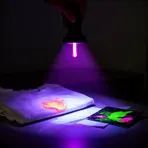
A lamp that makes some materials glow by using ultraviolet light
 1
3.9
1
3.9
A thing that gives light so you can see

A material that gives light when you turn it on or add a chemical

A device that gives off ultraviolet light used for lighting or experiments
How Bright

Surface Forms
Morphology
illuminant = illuminate (transparent) = illuminate + ant
Formed from the verb 'illuminate' with the productive agent/result suffix '-ant', so knowing the verb lets a learner infer 'a thing that produces light'.
Etymology
Illuminant comes from the Latin root lumin meaning 'light', the same root you see in luminous and illuminate. An illuminant is something that 'gives light', so the origin explains why it means a source of light.