
illuminance
- noun
- /ɪˈluː.mɪ.nəns/
- Specialized
- The recommended illuminance level for reading is about 300 lux to ensure comfort.
- preferred illuminance
- mean illuminance
- illuminance range
Examples
-
Consider a subject who prefers an illuminance of 50 lux.
Academic text (2010) -
Moore et al. recorded the illuminances preferred by 45 occupants in office buildings.
Academic text (2010) -
Table 2 shows the range of surface luminances at each of three levels of illuminance within these ranges.
Academic text (2010) -
The legend refers to the stimulus range and initial illuminance, Table 5.
Academic text (2010) -
The results revealed a significant difference in preferred illuminance between three stimulus ranges.
Academic text (2010) -
The preferred illuminances are either mean or median values, as reported in the original studies.
Academic text (2010) -
Further data are needed to compare the outcomes of this procedure with the high/low initial illuminance procedure.
Academic text (2010) -
The mean of these two values is used to provide an unbiased estimate of optimum illuminance.
Academic text (2010) -
An alternative approach would be to compare preferred illuminances for tasks of different difficulty using the same stimulus range.
Academic text (2010) -
Boyce et al. sought preferred illuminances in a windowless office from 18 test participants.
Academic text (2010)
Synonyms

 12
4.1
12
4.1

The amount of light in a place or on a surface
 3
8.5
3
8.5
The amount of light that falls on a surface
Antonyms

How Bright
37
3.3
 11
4.2
41
1.0
11
4.2
41
1.0
- Specialized
4
3.4
534
1.0
Surface Forms
Morphology
illuminance = illuminate (semi-transparent) = il + lumin + ance
The derivation from 'illuminate' to 'illuminance' involves a shift from action to measurement, which may not be immediately clear.
Etymology
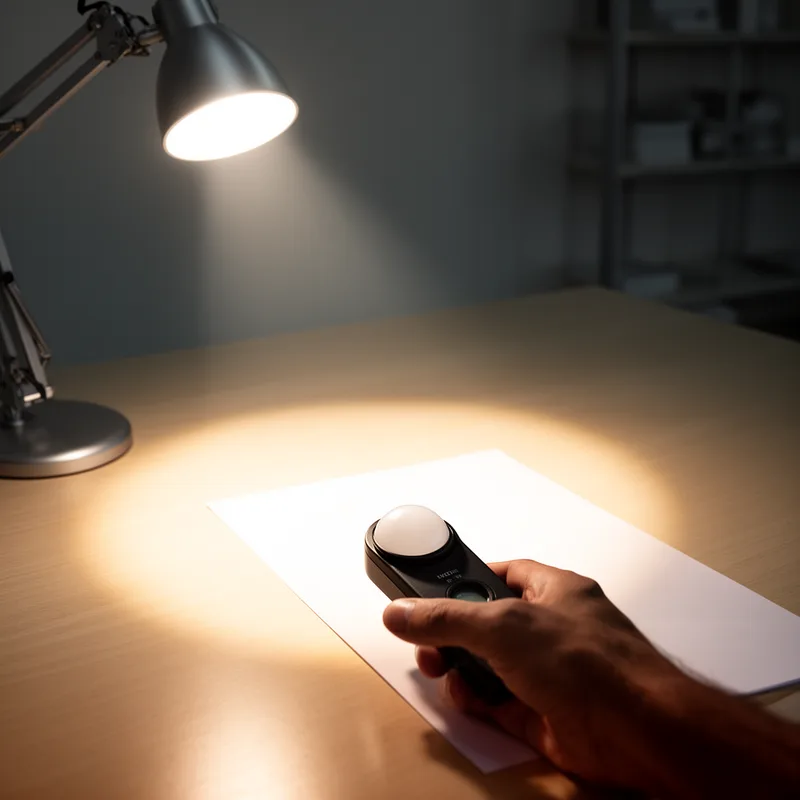
Illuminance comes from the Latin root lumen, which means 'light', and is the same root you see in illuminate ('to make light'). Think of it as how much light from a lamp falls on a desk, which is why illuminance measures the light that reaches a surface.