

to ice over
 2
3.4
2
3.4

- phrasal verb
- /aɪs ˈoʊvər/
- After a freezing rain, the roads iced over, causing numerous accidents in the morning.
- ice over the lake
- ice over the road
- starts to ice over
Loading YouTube…
Watch on YouTubeArticles in Bloomberg Apartment Markets have turned to ice over the past few months, says one Bloomberg article from today.
- Articles in Bloomberg Apartment Markets have turned to ice over the past few months, says one Bloomberg article from today.
Examples
-
During the night, the lake iced over, making it dangerous to walk on the surface.
-
It is 28 degrees with a heavy dew this morning, and the visor on his helmet had iced over, so he flipped it up, and then his glasses iced over.
Blog text (17) -
Like, it's all iced over.
-
It's iced over there, we can walk across, come on.
-
This time around, the bay was iced over, so no whales.
Blog text (10) -
A cold snap comes in October, freezing a skin of ice over the lake; it's got to be a shallow one, almost a marsh.
Fiction book (1998) -
Here at the equator, lakes and streams ice over in deep winter.
Fiction book (1999) -
The road was iced over, and it was snowing.
Fiction book (2000) -
The surface of the hole in the pond had iced over during the night, and she chipped at it using the stone left there by the boy.
Fiction book (1992) -
The cold snap caused the river to ice over, trapping some boats in the harbor.
Synonyms
 770
1.0
770
1.0
Become solid because of cold, like water turning to ice
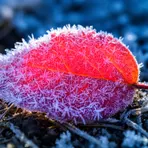 7
2.2
7
2.2
To cover or become covered with a thin layer of ice in very cold weather
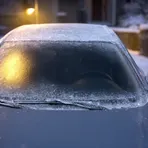 1
4.3
1
4.3
To form a layer of ice on something, making it slippery
 1
9.9
1
9.9
To become covered by ice or glaciers

 1
3.2
1
3.2
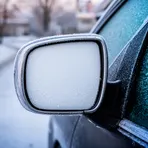
To get a thin layer of ice on windows or car mirrors
Antonyms

How Frozen

Surface Forms
Morphology
The meaning 'to become covered with a layer of ice' is directly and transparently derived from combining 'ice' (frozen water) with the particle 'over' indicating coverage or across a surface. This verb+particle composition follows common English patterns (and similar concepts exist cross-linguistically), so a B1 learner who knows the constituents would readily infer the meaning.
Etymology
The phrasal verb ice over shows the picture of ice forming over a surface: imagine a pond or a car window where ice spreads across and makes a hard sheet. So, it means 'to become covered with a layer of ice'.