

ice storm
 9
2.9
9
2.9

- noun
- /aɪs stɔrm/
- UK
- After the ice storm, branches were coated in a thick layer of ice, sparkling in the sunlight.
- ice storm hit
Loading YouTube…
Watch on YouTubeWhereas in the mid Midwest, our biggest risk tends to be an ice storm.
- Whereas in the mid Midwest, our biggest risk tends to be an ice storm.
- I was just reminded because there's ice storms and freezing rain and snow going on in other places than than here in Wisconsin.
Examples
-
And Central America is seeing our fair share of ice storms as well.
-
I survived the 2007 ice storm that cut across the Midwest.
Blog text (27) -
If it turns into an ice storm, we could be without power for at least a couple of days.
-
More snow fell that morning, followed by an ice storm.
Fiction book (1996) -
One of our first ice storms left a fantastic scene down by the lake where I live.
Academic text (1995) -
This is the first ice storm Jill warned us about!
-
An ice storm has ruled out any chance of air rescue by either side.
-
There's an ice storm heading your way and it looks bad.
-
Outside the window, everything was glazed with a fresh ice storm, blinding in the sun.
Fiction book (1998) -
In the Ozarks, the January ice storms come down out of Tornado Alley and glaze the roads sheer as mirrors.
Fiction book (1993)
Synonyms
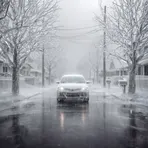
A storm when freezing rain covers everything in ice
How Much Ice

Surface Forms
Morphology
The meaning 'a storm in which freezing rain coats surfaces' is directly and transparently derived from combining 'ice' (frozen water) with 'storm' (a severe weather event): the first noun specifies the type of storm. This noun–noun compositional pattern is common across languages and would be immediately understandable to a B1 learner who knows both constituents.
Etymology
Ice storm comes from the clear image of rain that freezes into a hard layer of ice on roads, trees and power lines during a storm. That frozen coating makes roads slippery and can break branches or power lines, so the phrase 'ice storm' means a storm that causes dangerous travel and power outages.