
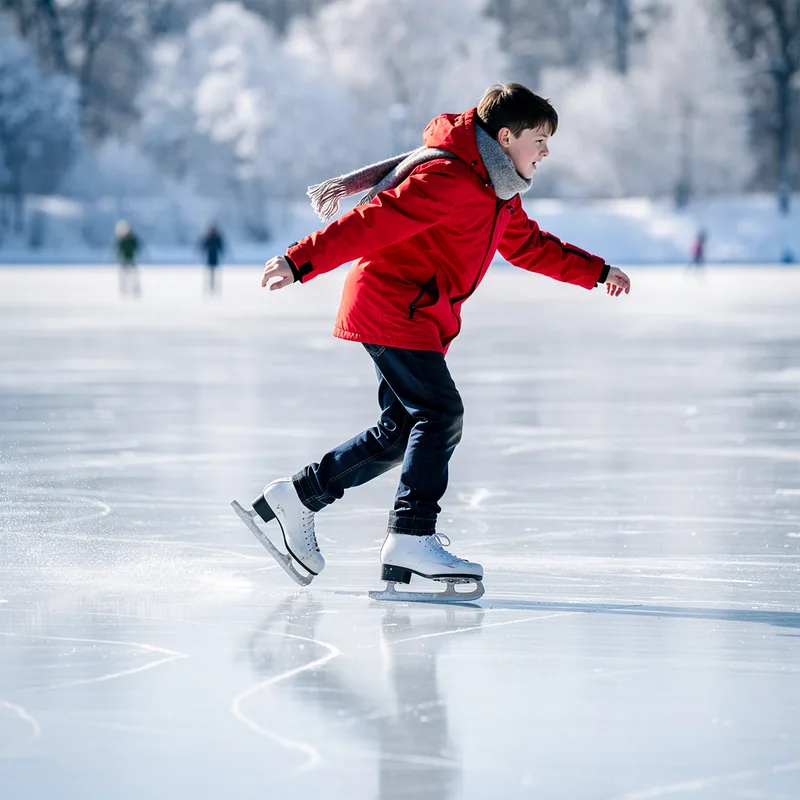
to ice skate
 5
1.9
5
1.9

- verb
- /aɪs skeɪt/
- You can ice skate in my classroom.
- learn to ice skate
- go ice skating
- ice-skating rink
Loading YouTube…
Watch on YouTubeI built snow Fort and ice skated with butcher blades.
- I built snow Fort and ice skated with butcher blades.
Examples
-
When did you learn how to ice skate?
-
D.R. didn't go skating this time, but she loves to ice skate, and she said she may go next time.
Blog text (23) -
Yes, I can ice skate.
-
Maybe we could ice skate across it in the winter...
Blog text (1) -
I taught myself how to ice skate and rollerblade.
Blog text (13) -
At the neck of the Peninsula, near the "Welcome to Presque Isle" sign, they watched some families ice skate.
Fiction book (1991) -
He bet they had some great places to ice skate in Quebec.
Fiction book (1991) -
Sean also tried to teach me that Rockefeller Plaza is the iconic place where people ice skate in the winter.
Blog text (17) -
She said we could ice skate, jump in leaf piles, and go to a place where people dressed up like pilgrims, and you could watch them spin wool, churn butter, and make candles.
Fiction book (1999) -
She loves to ice skate during the winter months at the local rink.
Synonyms
 305
1.0
305
1.0
To move smoothly using shoes with blades or wheels on a smooth surface
 1
4.4
1
4.4
To perform jumps and dance moves on ice while wearing skates

 1
3.9
1
3.9
To skate fast in races on ice
How Fast

Surface Forms
Morphology
The meaning 'to move or glide over ice using ice skates' is directly and compositionally derived from combining 'ice' (frozen surface) with 'skate' (to glide using skates). This location/modifier + verb pattern is common and transparent across languages and follows normal English verb + noun compounding, so a B1 learner knowing both constituents will readily infer the meaning.
Etymology
Ice skate as a verb comes from using an ice skate, the skate boot with a blade, to move across ice. So to ice skate means 'to glide or move over ice'.