
hyperplasia
 2
9.8
2
9.8

- noun
- /ˌhaɪpərˈpleɪʒə/
- Specialized
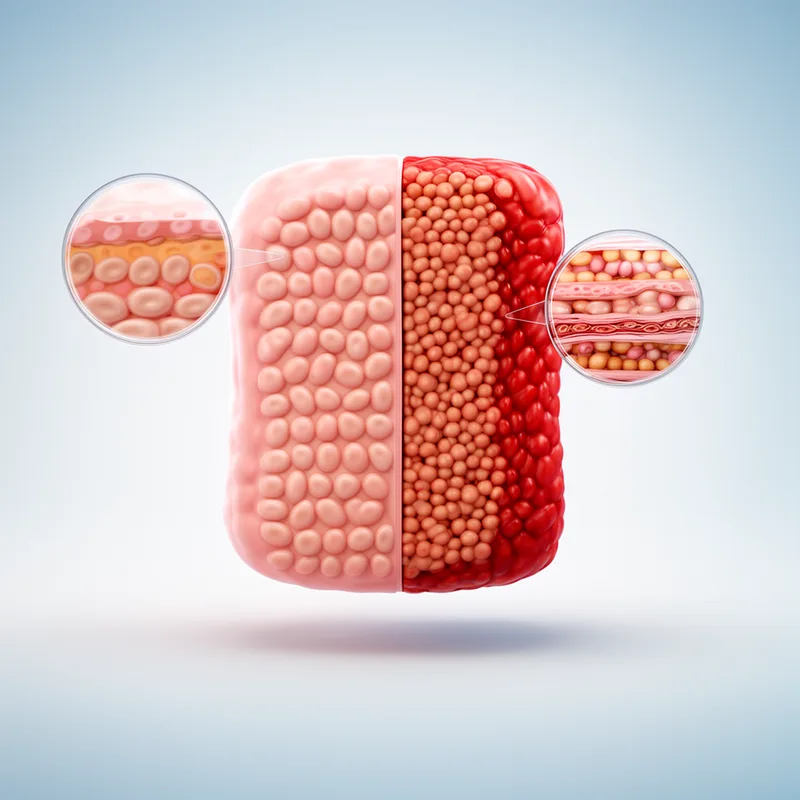
- An increase in cell numbers, known as hyperplasia, often causes the organ to enlarge.
- benign hyperplasia
- prostatic hyperplasia
- atypical hyperplasia
Loading YouTube…
Watch on YouTubeThere's several lobes of the prostate that tends to be especially enlarged in cases of BPH and BPH prostate hyperplasia or an enlarged prostate.
- There's several lobes of the prostate that tends to be especially enlarged in cases of BPH and BPH prostate hyperplasia or an enlarged prostate.
Examples
-
However, the differentiation between hyperplasia and oncocytoma has been the subject of much debate.
Academic text (2008) -
Neointimal hyperplasia is an early and essential step in the pathogenesis of atherosclerosis and restenosis.
Academic text (2012) -
Have them check it for lymphoid hyperplasia.
-
A high rate of bleeding or endometrial hyperplasia has also been reported in other trials.
Academic text (2002) -
In this review, they found only six reports of cancer and five cases of atypical ductal hyperplasia.
Academic text (2015) -
Studies show that pumpkin oil can benefit the treatment of benign prostate hyperplasia.
Academic text (2015) -
Hyperparathyroidism is frequently caused by the development of a parathyroid adenoma and less often by hyperplasia or carcinoma.
Academic text (2005) -
The potential inhibitory effects of this drug on intimal hyperplasia and SMC proliferation were investigated.
Academic text (2012) -
The oral cavity appeared normal; however, indirect laryngoscopy revealed mild hypopharyngeal erythema with hyperplasia of the adenoidal bed.
Academic text (2008) -
The three most common prostate problems are an enlarged prostate (benign prostatic hyperplasia or BPH), prostatitis, and prostate cancer.
Academic text (2012)
Synonyms
 1
7.1
1
7.1
An unusual increase in size of a body part or tissue

An unusually large number of cells in a body part, often showing disease

Too much growth of a body part or tissue that makes it too large and may cause problems
Antonyms
Compounds

- Specialized
An enlargement of the prostate gland that is not cancer and often makes it hard to pee
How Enlarged

Surface Forms
Morphology
hyperplasia = hyper + plasia
Although 'hyper-' is a recognizable prefix meaning excessive, the remaining combining form '-plasia' is technical and not a transparent standalone English base, so the full meaning is not easily predictable for a typical learner.
Etymology
Hyperplasia comes from two Greek parts: hyper- meaning 'over' (as in hyperactive) and -plasia meaning 'formation' (the same root in plastic, which is about forming). So hyperplasia literally means 'over-formation' and refers to an extra growth in the number of cells that makes a tissue larger.