
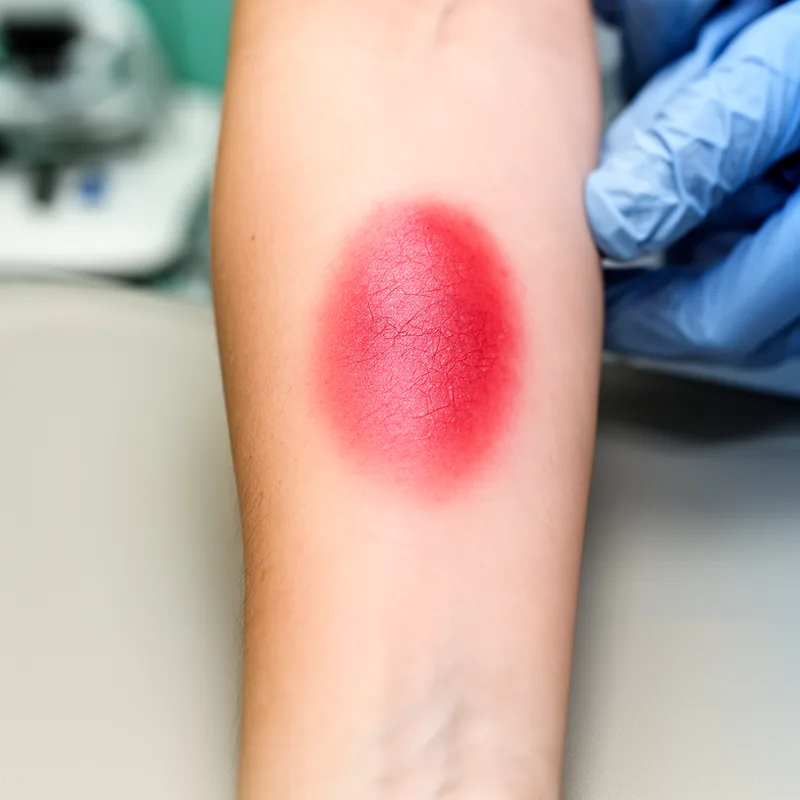
hyperemic


 1
9.9
- adjective
- /ˌhaɪpəˈrimɪk/
- Specialized
- The medical examination showed a hyperemic condition in the affected tissue, suggesting inflammation.
Examples
-
Histopathology of the organs in the birds infected through the intranasal route revealed severe hyperemic trachea and congested lungs.
Academic text (2015) -
Examination of the infected ear may reveal pale-yellow granulation tissue on a thickened, hyperemic tympanic membrane.
Academic text (2005) -
The duration of the hyperemic response in these previous reports is also shorter compared to the present study.
Academic text (1991) -
The skin covering the mass was hyperemic, raising the suspicion of tumoral infiltration.
Academic text (2008) -
Examination of the affected ear will usually reveal pale-yellow granulation tissue on a thickened and hyperemic tympanic membrane.
Academic text (2002) -
Holloway (8), studying the effect of local pressure application on skin blood flow, observed a reactive hyperemic effect upon pressure release for pressures of 90 mmHg or larger, applied for 90 seconds.
Academic text (1991) -
During the postmortem examination, grossly hyperemic trachea, congested lungs, and swollen kidneys were observed (Figure 1 and 2).
Academic text (2015) -
The skin covering the wound appeared hyperemic, indicating increased blood flow to the area.
-
After the long run, her cheeks were hyperemic and flushed due to the enhanced blood circulation.
How Congested

Surface Forms
Morphology
hyperemic = hyperemia (transparent) = hyper + emia + ic
The adjective is a regular derivation from the medical noun 'hyperemia' with the suffix -ic, meaning 'relating to'.
Etymology
The word hyperemic comes from the parts hyper- meaning 'over' and hem- meaning 'blood', as in hemoglobin. So, hyperemic describes tissue that has 'too much blood' and often looks red and swollen.