

hypercellularity
- noun
- /ˌhaɪpərsəˈljuːlɛrɪti/
- Specialized
- The doctor explained that hypercellularity in the biopsy indicates a potential disease process.
Examples
-
The presence of hypercellularity and atypia may lead to the misdiagnosis of these lesions as sarcomas.
Academic text (2007) -
The biopsy was composed of slender spindled cells in a loose, fibrous background with focal areas of hypercellularity alternating with hypocellular areas (Figure 3).
Academic text (2007) -
They described pathologic characteristics such as large areas of hyalinized matrix, increased hypercellularity with nuclear pleomorphism, and hyperchromatism.
Academic text (2007) -
Aggressiveness is usually thought to be associated with large size, hypercellularity, increased mitoses, pleomorphism, necrosis, and hemorrhage, but these are unreliable.
Academic text (1996) -
Histopathologic analysis of the grade I chondrosarcoma demonstrates a clustering arrangement of the chondrocytes, hypercellularity, hyperchromasia, and mild pleomorphism.
Academic text (2001) -
During the examination, the pathologist noted hypercellularity, which often suggests an abnormal condition in the tissue.
-
The report highlighted hypercellularity as a key feature, signaling the possibility of an underlying illness.
Synonyms

 2
9.8
2
9.8

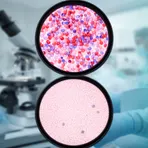
An abnormal increase in the number of cells in a part of the body that makes it larger
Antonyms
How Many

Surface Forms
Morphology
hypercellularity = cellularity (semi-transparent) = hyper + cell + ular + ity
The word is a straightforward prefixation of 'hyper-' to 'cellularity', and the medical meaning 'excessive cellularity' follows the form closely.
Etymology
Hypercellularity comes from the part hyper- meaning 'over', as in hyperactive, and cell meaning 'a small unit of the body'. So, hypercellularity means having 'too many cells' in a tissue, which often shows disease.