
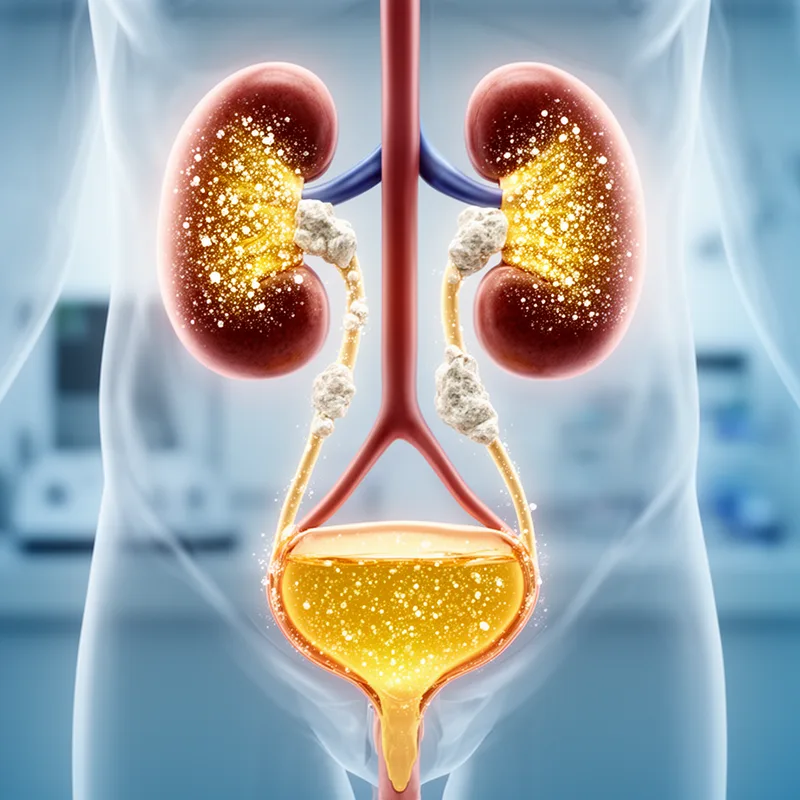
hypercalciuria


 1
9.6
- noun
- /ˌhaɪpərˌkælˈsɪʊəriə/
- Specialized
- The incidences of new cases of hypercalciuria and fractures have been compared between groups using Pearson's chi-square.
- hypercalciuria and hypercalcemia
- case of hypercalciuria
Examples
-
Other laboratory indicators of Paget's disease may include hypercalciuria and hypercalcemia, which are rare but can occur with immobilized patients.
Academic text (2004) -
Doctors often monitor patients for hypercalciuria, especially those with osteoporosis, to prevent complications.
-
No case of clinical hypercalciuria or hypercalcemia has been recorded.
Academic text (2007) -
There is a family history of kidney stones in more than a third of cases, and hypercalciuria is commonly found (panel).
Academic text (1996) -
The fact that there was no single case of clinically relevant hypercalcaemia nor hypercalciuria during the two-year period in none of the groups confirmed the safety of the combination therapy.
Academic text (2007) -
These possibilities are being explored to further define the role of CLC-5 in the aetiology of hypercalciuria and renal stones.
Academic text (1996) -
He had proteinuria (1 g per 24 h), predominantly of beta-2-microglobulin, and hypercalciuria.
Academic text (1996) -
As an alternative to controlling the hypercalciuria, we are trying a combination of a low-calcium/low-sodium diet, with added oral potassium and sodium cellulose phosphate.
Academic text (1996) -
Treatment with oral sodium bicarbonate (10 g/day at first, later 5 g/day) was started, and the acidosis, hypokalaemia, bone disease, and hypercalciuria resolved.
Academic text (1996) -
Dent's disease, as diagnosed in this case, is an X-linked form of proximal renal tubular disease; it commonly causes hypercalciuria, nephrocalcinosis, and eventually, renal failure.
Academic text (1996)
Synonyms
An excess of calcium in the urine often linked to kidney stones
Surface Forms
Morphology
hypercalciuria = calciuria (semi-transparent) = hyper + calci + uria
The base term calciuria is medically compositional, but the specialized combining form calci- is not fully transparent to an average learner.
Etymology
Hypercalciuria breaks into three parts you may already know: hyper- means 'too much' (as in hyperactive), calci- comes from calcium (the mineral in milk and bones), and -uria means 'urine'. So hypercalciuria simply means 'too much' calcium in the 'urine', which is why it is linked to kidney stones and bone problems.