
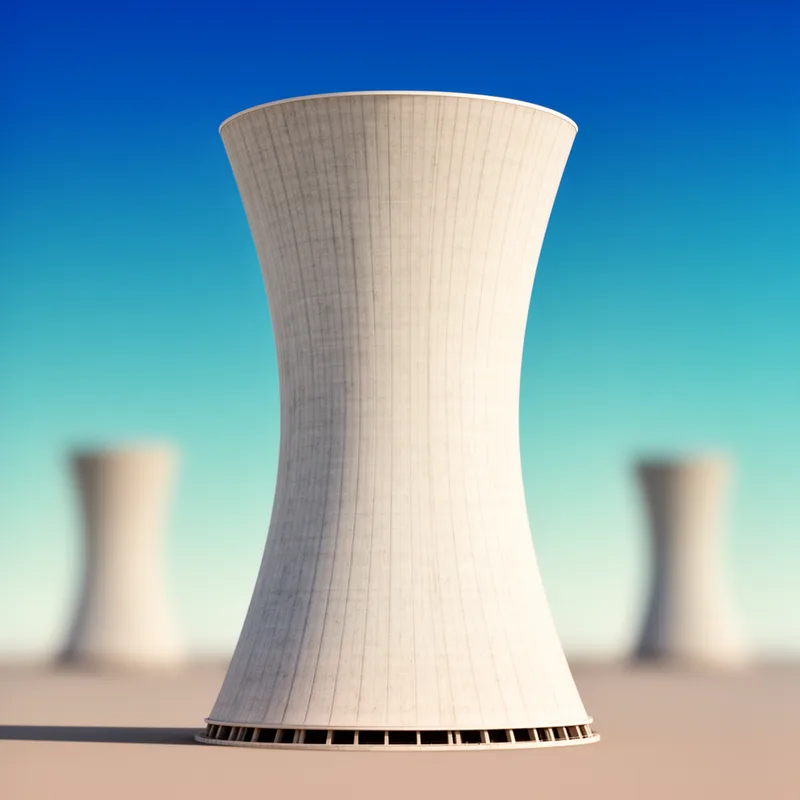
hyperboloid


 1
9.9
- noun
- /haɪˈpɜrbəˌlɔɪd/
- Specialized
- So very simple equation for a hyperboloid in cylindrical and cylindrical a couple more and then we'll call it quits.
Examples
-
Well, each one of these hyperboloids is a different value of rho.
-
The architect used a hyperboloid structure to create an eye-catching design for the new museum.
-
If you do things that way, then this hyperboloid is absolutely uniform.
-
This is going to be a quadric that has the shape of an hyperboloid of two sheets.
-
So one is primary mirror which is concave hyperboloid hyperboloid mirror.
-
HST's mirror was designed to be a precisely calculated shape called a hyperboloid.
Academic text (1990) -
Two end caps are oriented above and below the ring electrode to form a hyperboloid of two sheets.
Academic text (1998) -
Wolter had calculated that a reflector combining both paraboloid and hyperboloid segments should do the trick.
Academic text (2002) -
Chandra's four nested hyperboloid-paraboloid reflectors provide an unprecedented imaging angular resolution of better than 1 arcsecond (see the image above).
Academic text (2002) -
A quadrupolar ion trap consists of three electrodes with rotational symmetry about the z-axis and with the surface of the center (ring) electrode forming a hyperboloid of one sheet.
Academic text (1998)
Surface Forms
Morphology
Etymology
Hyperboloid comes from the curve hyperbola, a shape that 'bends in and out', and the ending -oid meaning 'like' or 'shape', as in asteroid. So a hyperboloid is a three-dimensional shape 'like' a hyperbola turned around its main line, which is why it curves inward and outward.