
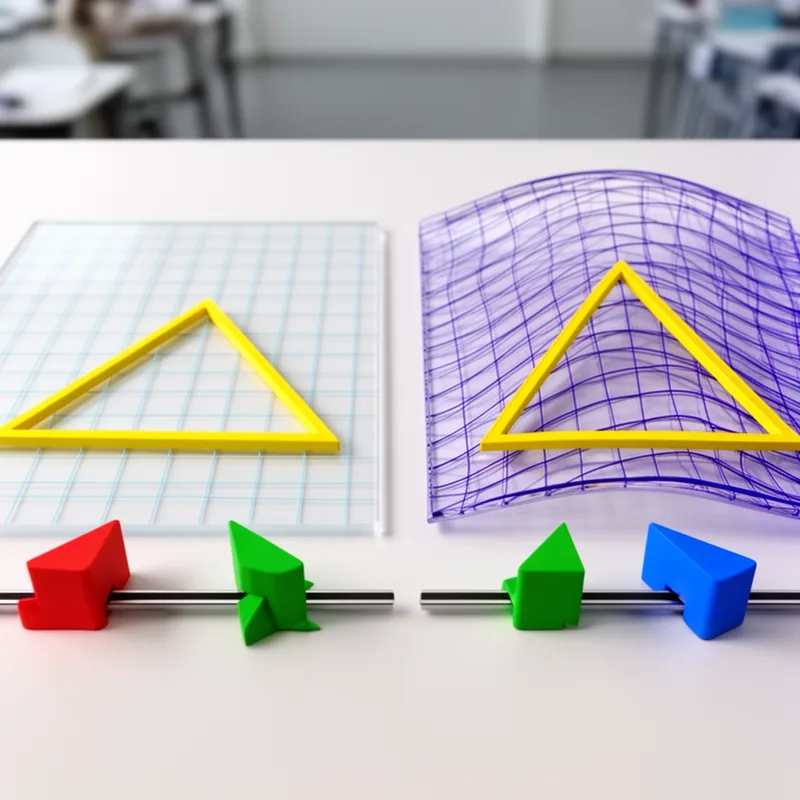
hyperbolic geometry
- noun
- /ˌhaɪpərˈboʊlɪk dʒiˈɒmɪtri/
- Specialized
- In hyperbolic geometry, there are infinitely many parallel lines through a point not on a given line.
Examples
-
It was proven by Benuzza that you can embed the hyperbolic geometry infinitely large in a six dimensional space.
-
The study of hyperbolic geometry offers insights into the properties of space that differ from traditional Euclidean concepts.
-
Mathematics students often find hyperbolic geometry fascinating due to its unique parallel line properties.
Surface Forms
Morphology
The phrase is compositionally regular (adjective + geometry) so a learner who knows 'hyperbolic' and 'geometry' can infer it names a type or branch of geometry. However, the technical content (that it is a specific non-Euclidean system with particular parallel-line properties) is specialized and not predictable at B1, and the adjective 'hyperbolic' may be ambiguous (common 'exaggerated' sense) without subject-matter knowledge, so the expression is only partially transparent.
Etymology
Hyperbolic geometry comes from Greek parts: hyper means 'beyond' and the rest means 'to throw', so imagine a space pushed beyond the usual flat space. That's why the name describes a kind of geometry where lines and angles behave differently from 'normal' geometry, for example triangles can have less than 180 degrees.

