
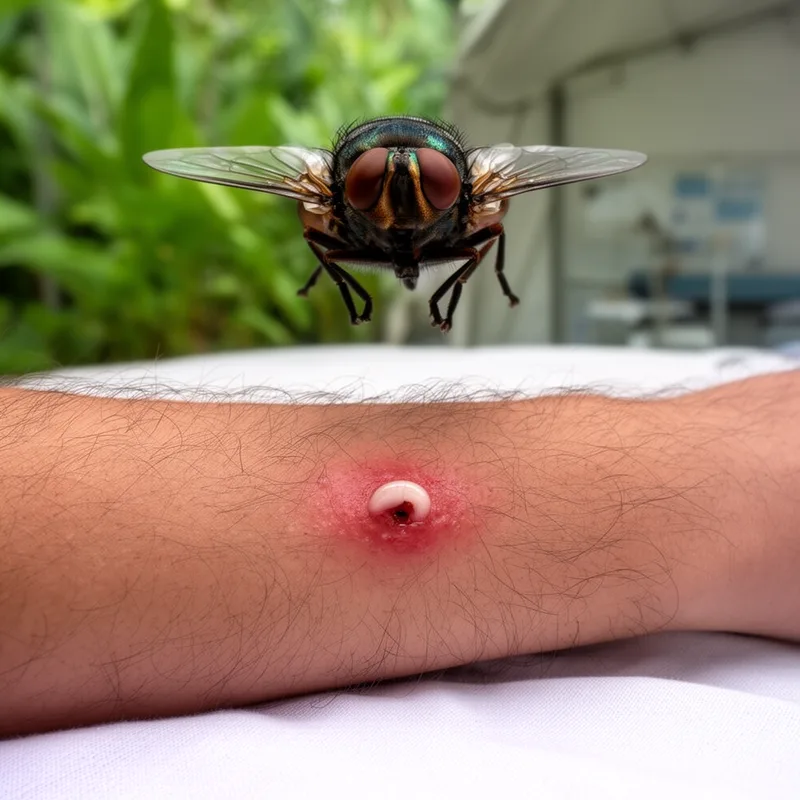
human botfly
- noun
- /ˈhjuːmən ˈbɒtˌflaɪ/
- US
- The human botfly is known for its painful larvae.
Examples
-
Doctors removed a human botfly larva from the patient's arm after their return from the rainforest.
-
The human botfly is notorious for laying its eggs on the skin of mammals.
-
Travelers to parts of Central and South America are warned about the risks of human botfly infestation.
-
Have you ever heard of the human botfly?
-
The human botfly lays its eggs in the skin of mammals, causing painful infections.
-
While hiking in the rainforest, we learned about the dangers of the human botfly and its parasitic larvae.
-
He had to see a doctor after discovering a human botfly larva embedded in his arm.
Synonyms

 1
9.9
1
9.9

A large hairy fly whose larvae grow under the skin of mammals and cause pain
A large tropical fly whose young grow under the skin of people and animals

A large fly whose young live under the skin of mammals such as humans and cattle
Surface Forms
Morphology
The meaning is directly compositional: 'human' (pertaining to people) modifies 'botfly' (a fly whose larvae infest mammals), yielding a botfly that parasitizes humans. This attributive modifier + noun pattern is common and readily interpretable by a B1 learner who knows both constituents.
Etymology
Human botfly is named for what it does: the botfly lays eggs on a human, and the young insects hatch and grow under the skin. So, the name means a fly whose 'young live inside people'.