

to house-train
 1
3.5
1
3.5

- phrasal verb
- /ˈhaʊs treɪn/
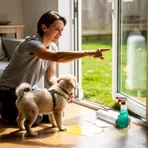
- To prevent accidents indoors, you need to house-train your new dog carefully.
Examples
-
Imagine, if you will, all the work that goes into house-training a puppy.
Blog text (33) -
You can house train them, and they can find fungi.
-
- The news is, I, uh... I finally house-trained Odie.
-
Dachshund hounds are really, really hard to house train.
Blog text (1) -
About 3 years old, so you don't have to house train it, and it is already calm and not jumpy and hyper, which may scare you.
Blog text (1) -
This stress can manifest in a variety of unpleasant ways, from house-training accidents to chewing to even fearfulness or fear aggression.
Blog text (2) -
We used the kennel to house train our first dog, stopped when he was fully housebroken, and then came back two years later and decided we needed to use the kennel again (he was stealing food when unattended).
Blog text (16) -
It took several weeks, but finally, she managed to house-train her puppy.
-
We used a rewards system to house-train our puppy successfully.
Synonyms
 2
4.2
2
4.2
Teach a pet not to pee or poo inside the house
Surface Forms
Morphology
Etymology
House-train comes from the parts house and train and literally means to 'teach' a pet to live and behave in the 'house'. So to house-train a puppy is to teach it where to go to the toilet and how to act inside your home.