
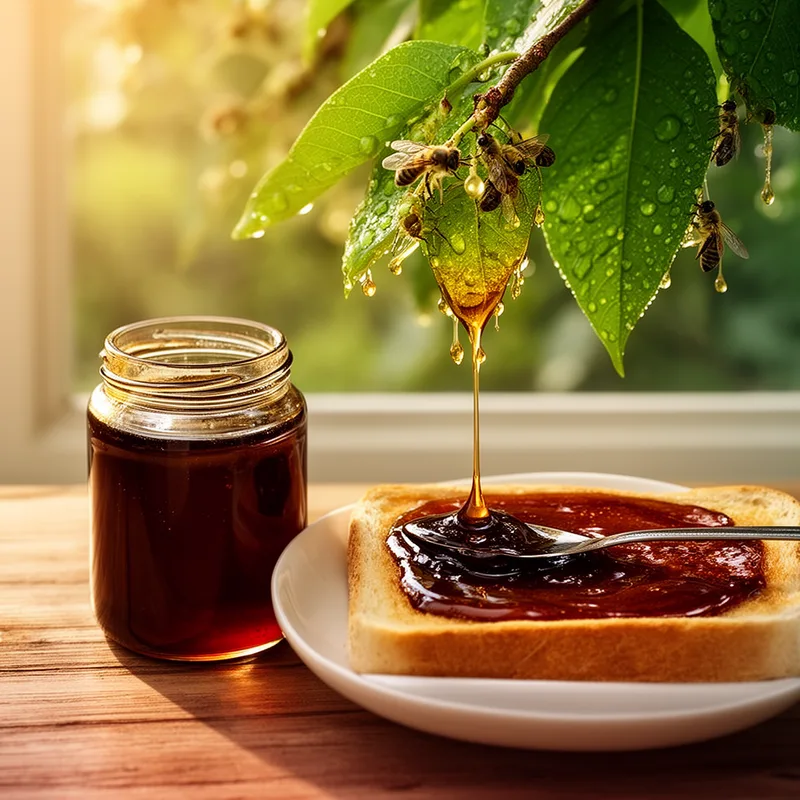
honeydew honey
- noun
- /ˈhʌnidjuː ˈhʌni/
 :
miel de mielada
:
miel de mielada
- Unlike floral honey, honeydew honey is prized for its deep, complex flavor.
Examples
-
The beekeeper offered samples of honeydew honey for customers to taste at the market.
-
Some people prefer honeydew honey on toast because it is less sweet but more aromatic.
-
I love honeydew honey on my toast.
-
Have you tried honeydew honey from New Zealand?
-
Many chefs enjoy using honeydew honey in dressings due to its rich aroma and unique flavor.
-
At the farmer's market, I found a vendor selling organic honeydew honey harvested from local bees.
-
My favorite way to sweeten tea is with honeydew honey, as it adds depth without overwhelming sweetness.
Synonyms

 305
1.0
305
1.0

A sweet thick liquid made by bees from flowers used as food
Surface Forms
Morphology
The noun–noun compound is fully compositional: 'honeydew' names the source (aphid/scale excretion) and 'honey' names the product, so the meaning 'honey produced from honeydew' is directly derivable from its parts. This source+product pattern is a common English compounding strategy (and has parallels in other languages), making the phrase immediately comprehensible to a B1 learner who knows both constituents.
Etymology
Honeydew honey comes from what bees collect: they gather a sweet honeydew, the sticky 'dew' left on leaves by plant bugs, not from flower 'nectar'. So honeydew honey means honey made from that leaf 'dew', which is why it is darker and has a richer, less sweet taste.