
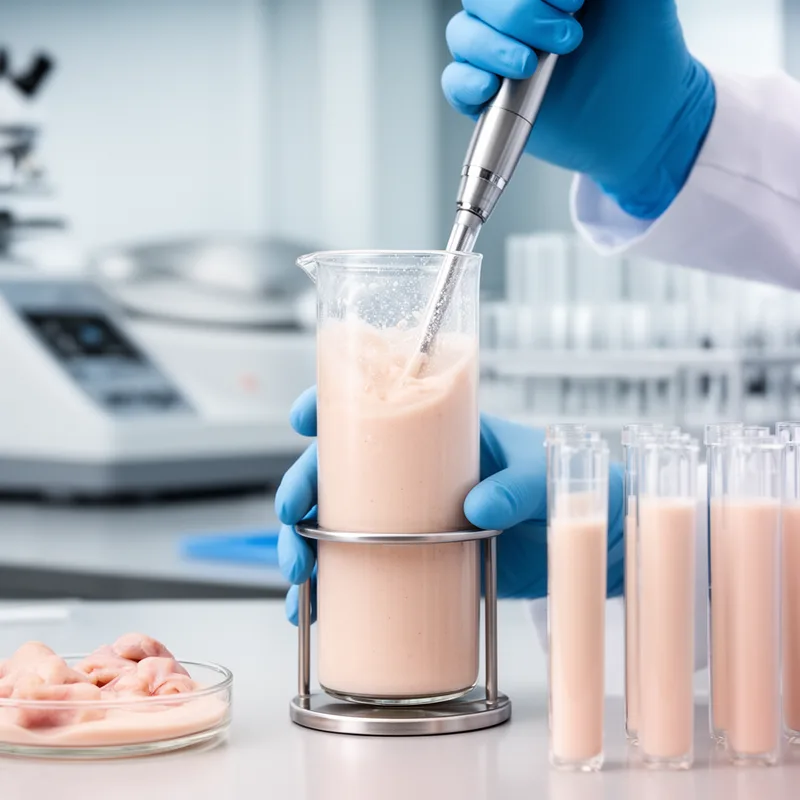
homogenate


 1
8.6
1
8.6
- noun
- /həˈmɒdʒəneɪt/
- Specialized
- The moisture content of the cut tobacco homogenate was estimated by loss of oven volatiles and was determined in three sub-samples of the material.
- brain homogenate
- tissue homogenate
- 10% homogenate
Examples
-
The homogenate was centrifuged for 10 minutes at 3000 rpm.
Academic text (2015) -
In the first experiment (Table 2), we used a brain homogenate from a unique terminally sick animal.
Academic text (2013) -
Preparation of cut tobacco homogenate for total determination of cadmium.
Academic text (2018) -
Inocula were prepared from brain tissues as 10% (wt/vol) homogenates.
Academic text (2013) -
Tissue homogenates were centrifuged at 10,000 g for 15 min at 5 degrees C.
Academic text (1995) -
Before testing, we prepared 10% tissue homogenates in RPMI medium (Life Technologies, Carlsbad, CA, USA) containing antimicrobial drugs.
Academic text (2012) -
The scientist analyzed a sample of brain tissue homogenate to study its properties.
-
Before the experiment, researchers created a homogenate from the plant tissue to ensure consistent results.
-
We extracted DNA from the animal homogenate to investigate its genetic material.
How Mixed
- Specialized
1
8.6
 98
2.3
98
2.3
- Specialized
55
3.5
553
2.3
Surface Forms
Morphology
homogenate = homogeneous + homogenize (semi-transparent) = homo + gen + ate
The word is built from the combining form 'homogen-' (homo- + gen-) plus the productive suffix '-ate'; the relation to 'making uniform' is clear in scientific contexts but the combining form and technical suffix may be unfamiliar to many learners.
Etymology
The word homogenate comes from homo- ('same') and gen- ('kind' or 'type') and is related to homogenize, which means to make things evenly mixed. So a homogenate is a sample that has been ground and mixed until it is 'the same' throughout, like making a lab smoothie.